
.webp)
Every October, more than 10,000 Year 12 students across Western Australia file into exam halls for their WACE written exams. In 2025, 10,265 students received an ATAR, up from 9,992 the year before (SCSA data, via Learnmate, 2025). Most parents know the exams matter. Fewer know how long they run, what their child can bring in, or how the marks actually get decided. So what actually happens once your child sits down? This guide walks through the written exam format subject by subject, so nothing on the day is a surprise.
Key Takeaways
- Most WACE written exams run 3 hours plus 10 minutes reading time, but Mathematics splits into calculator-free and calculator-assumed sections (SCSA, 2026).
- Science exams weight multiple-choice, short-answer and extended-answer sections differently than essay-based humanities exams like English.
- Students can bring up to three SCSA-approved calculators, but personal notes are banned outside one specific Maths allowance.
- Every script is marked by at least two anonymised markers, with a third called in if they disagree.
How Long Do WACE Written Exams Run?
Most ATAR written exams run for 3 hours, plus 10 minutes of reading time, unless SCSA specifies otherwise for a particular subject (School Curriculum and Standards Authority, 2026 examination information). That standard covers subjects like English, History and Human Biology. Mathematics is the exception, split into two timed sections instead of one continuous block.
Section 1, calculator-free, gives students 5 minutes reading time and 50 minutes to work. Section 2, calculator-assumed, allows 10 minutes reading time and 100 minutes of working time. Add it up and it's still around 2.5 hours of exam time, just split into two very different mental modes.

A student's hand writing on exam paper with a pencil during a written examination
Our experience: Students who rehearse using their reading time to plan a response, not just skim the paper, consistently finish stronger. Ten minutes feels short until you've actually practised using it.
WACE written exams standardly run three hours with ten minutes of reading time, except Mathematics, which splits into a 50-minute calculator-free section and a 100-minute calculator-assumed section (SCSA, 2026). That structural difference is unique to Maths among ATAR subjects, and it changes how students should pace their revision.
For the full day-by-day schedule, see our WACE Exam Timetable guide for exact session dates and times.
How Does Exam Structure Differ Between Sciences, Humanities and Maths?
Chemistry's written exam runs 2.5 hours and splits into three sections: 20 multiple-choice questions worth 25% of marks, short-answer questions worth 35%, and extended-answer questions worth the remaining 40% (SCSA Chemistry ATAR syllabus, 2024). English works on an entirely different model, built around three skills instead of three difficulty tiers.
The English exam asks students to analyse an unseen text (Comprehending, worth 30 marks), argue a sustained case in an essay (Responding, worth 40 marks), then produce a piece of creative or persuasive writing (Composing). Where science exams reward precision across many short, separately-marked answers, English rewards a sustained argument across fewer, longer pieces. Isn't it worth knowing which mode your child needs to train for?
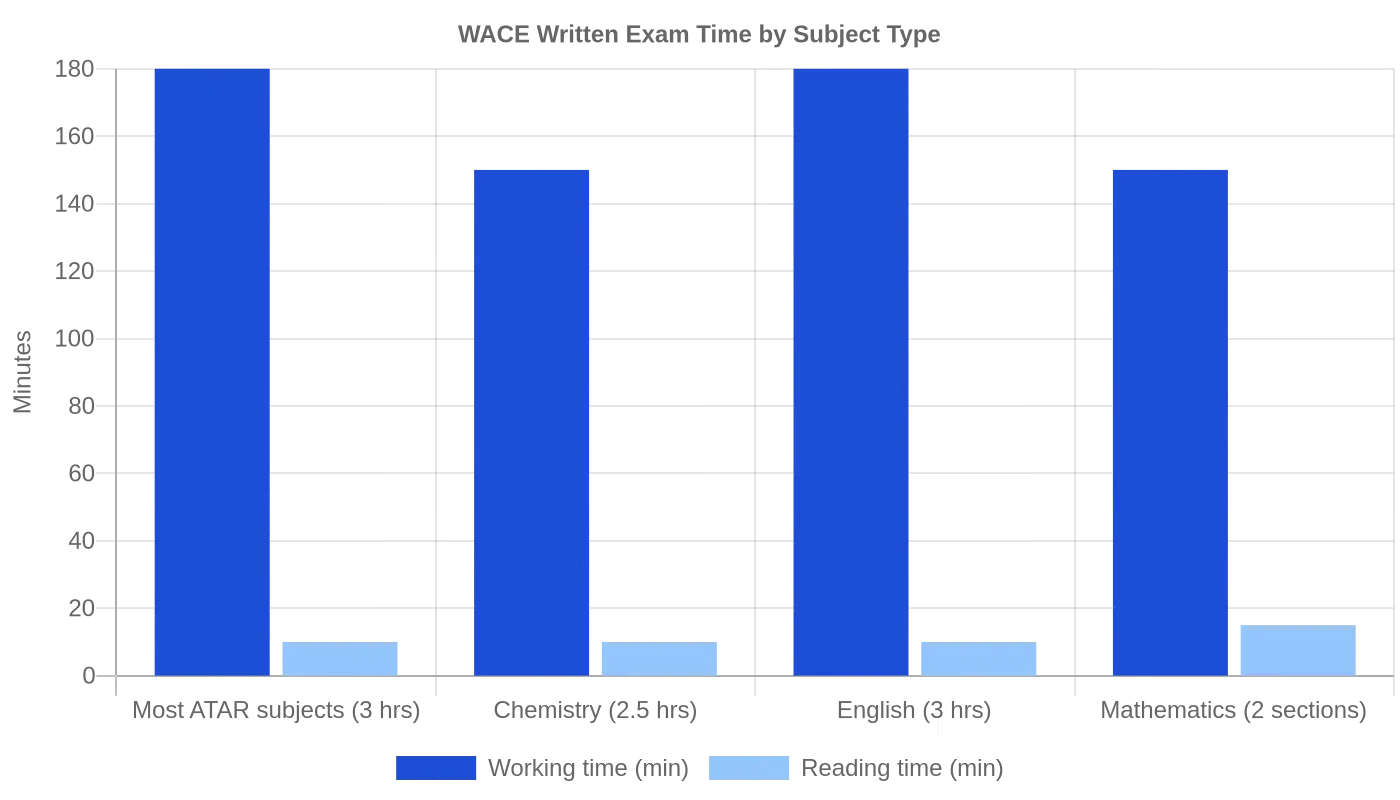
WACE written exam time by subject type, comparing working time and reading time in minutes for standard ATAR subjects, Chemistry, English and Mathematics
Source: SCSA Examination Information, 2026 cycle.
Maths, as covered above, is structured around calculator access rather than answer length or section weighting. Knowing which model applies to your child's subjects should shape how they revise in the final weeks, not just what they revise.
Browse our WACE subject guides for a breakdown of what each individual course covers.
What Can Students Bring Into the Exam Room?
Standard equipment for every WACE written exam includes pens, pencils, a ruler, an eraser and correction tape, but personal notes are banned in almost every subject (SCSA Rules of Conduct for ATAR Course Examinations). Mathematics is the one notable exception.
Students sitting Mathematics Methods, Specialist or Applications can bring up to two A4 sheets of handwritten notes, but only for use in the calculator-assumed section. Up to three SCSA-approved calculators are allowed in that section too, drawn from an approved list of CAS, graphic and scientific models. Formula sheets, where a subject uses one, are supplied by SCSA in the exam room itself. Dictionaries are only permitted for LOTE and other nominated exams.
A student studying at a desk at night, focused on completing written work
A mistake we see often: Families assume any scientific calculator will do. It won't. SCSA publishes an approved calculator list every year, and a device that isn't on it can be confiscated on the day, notes and all.
Our exam-readiness checklist covers what to pack and check the night before.
How Does SCSA Mark WACE Written Exams?
Every WACE written script is marked independently by at least two qualified markers, who see only a candidate number, never a student's name or school (SCSA marking process). If the two markers disagree, a third marker resolves the difference before a final mark is locked in.
Marking happens on a secure online platform, with marker accuracy monitored throughout the process rather than checked only at the end. Once exam marks are finalised, SCSA doesn't simply average them with a student's school-based assessment marks. It runs a statistical moderation process that adjusts each school's assessment marks against how that same cohort performed in the external exam, so one school's grading standard can't advantage or disadvantage its students (SCSA course score calculation methodology).
SCSA marks every WACE written exam twice, using markers who see only a candidate number and never a student's identity, with a third marker settling any disagreement. School-based marks are then statistically moderated against exam performance, not simply averaged, so grading standards stay consistent across every WA school (SCSA).
How Can Parents Help Their Child Prepare?
Personalised WACE exam timetables land in the student portal from 8 September 2026, giving families roughly seven weeks' notice before the first written exam on 28 October (SCSA 2026 ATAR examination timetable). That window is your cue to lock in a study schedule, not scramble once the timetable drops.
From there, the most useful thing parents can do is protect exam-day logistics: confirmed start times, transport, and a calculator that's actually on SCSA's approved list. Inside the study itself, timed practice under real exam conditions, reading time included, tends to matter more than extra content revision in the final fortnight. Wouldn't you rather your child's first timed attempt happen weeks before the real thing, not on it?
What we tell ATA families: The students who cope best on exam day aren't always the ones who've covered the most content. They're the ones who've rehearsed the format enough that nothing feels unfamiliar.
Ready to help your child walk into their WACE written exam prepared? Apply for tutoring with Apex Tuition Australia and get exam-condition practice built into their sessions.
Frequently Asked Questions
How many students received a WACE ATAR in 2025?
10,265 WA students received an ATAR in 2025, up from 9,992 in 2024 (SCSA data, via Learnmate, 2025). That year-on-year growth means written exam halls are getting busier, not smaller, so early preparation and familiarity with the format matter more each year.
When do WACE written exams run in 2026?
Written exams run from Wednesday 28 October to Thursday 19 November 2026, with personalised student timetables released from 8 September 2026 (SCSA 2026 ATAR examination timetable). That's roughly seven weeks of notice, enough time to build a realistic study and practice-exam schedule.
Can students bring their own calculator into a WACE exam?
Yes, but only calculators from SCSA's approved list, up to three per student in Mathematics exams (SCSA Rules of Conduct for ATAR Course Examinations). CAS, graphic and scientific models are permitted, but they must be silent, non-programmable beyond approved functions, and checked against the current year's list.
What happens if two exam markers disagree on a mark?
A third marker is brought in to resolve the disagreement before a final mark is confirmed (SCSA marking process). Every script is marked at least twice by markers who never see the student's name, keeping the process consistent across WA's roughly 10,000 ATAR candidates each year.
Conclusion
WACE written exams aren't one uniform test. Duration, section structure and permitted materials all shift depending on whether your child is sitting a science, a humanities subject or Mathematics. Knowing the format in advance, three hours here, a calculator-free section there, turns exam day from an unknown into a plan.
Marking follows a defined process too: double-marked, anonymised, and statistically moderated against school assessment rather than simply averaged. The 2026 exam period runs from 28 October to 19 November, with timetables landing in early September. That gives your family a real window to prepare properly, not just react to it.