

.webp)
Most WA families assume school assessment and the external exam split every WACE course 50/50. It's not that simple. Chemistry ATAR really does run 50% school assessment and 50% exam, but English ATAR weights school assessment at 70% and the exam at just 30% (SCSA Year 12 syllabi, 2024–2025). So how is your child's internal mark actually built, and why might it shift once SCSA gets involved? Here's the process, step by step.
Key Takeaways
- School-assessed versus exam weighting varies by course, not a fixed 50/50 (SCSA Year 12 syllabi, 2024–2025).
- Schools must follow an SCSA-mandated assessment outline, using every listed assessment type at least once a year.
- Consensus moderation aligns marking standards across schools on selected courses each year, via shared review of student work.
- Statistical moderation rescales a school's marks to match its own exam performance. It preserves each student's rank among their classmates; it doesn't demote or promote anyone relative to their peers.
What Actually Makes Up a Student's School-Assessed Mark?
Weighting between school assessment and the external exam depends entirely on the course. Chemistry ATAR splits 50% school assessment and 50% exam, while English ATAR runs 70% school assessment and 30% exam (SCSA Year 12 syllabi, 2024–2025). Practical subjects add a third layer entirely.
Physical Education Studies ATAR, for example, combines a 70% written component (itself split into a 15% investigation, 30% response and 55% written exam) with a separate 30% practical performance test, assessed externally by SCSA (PE Studies ATAR Year 12 Syllabus, 2025). Every course publishes its own weighting in its syllabus document, so it's worth checking the specific breakdown for each of your child's subjects rather than assuming a standard split.
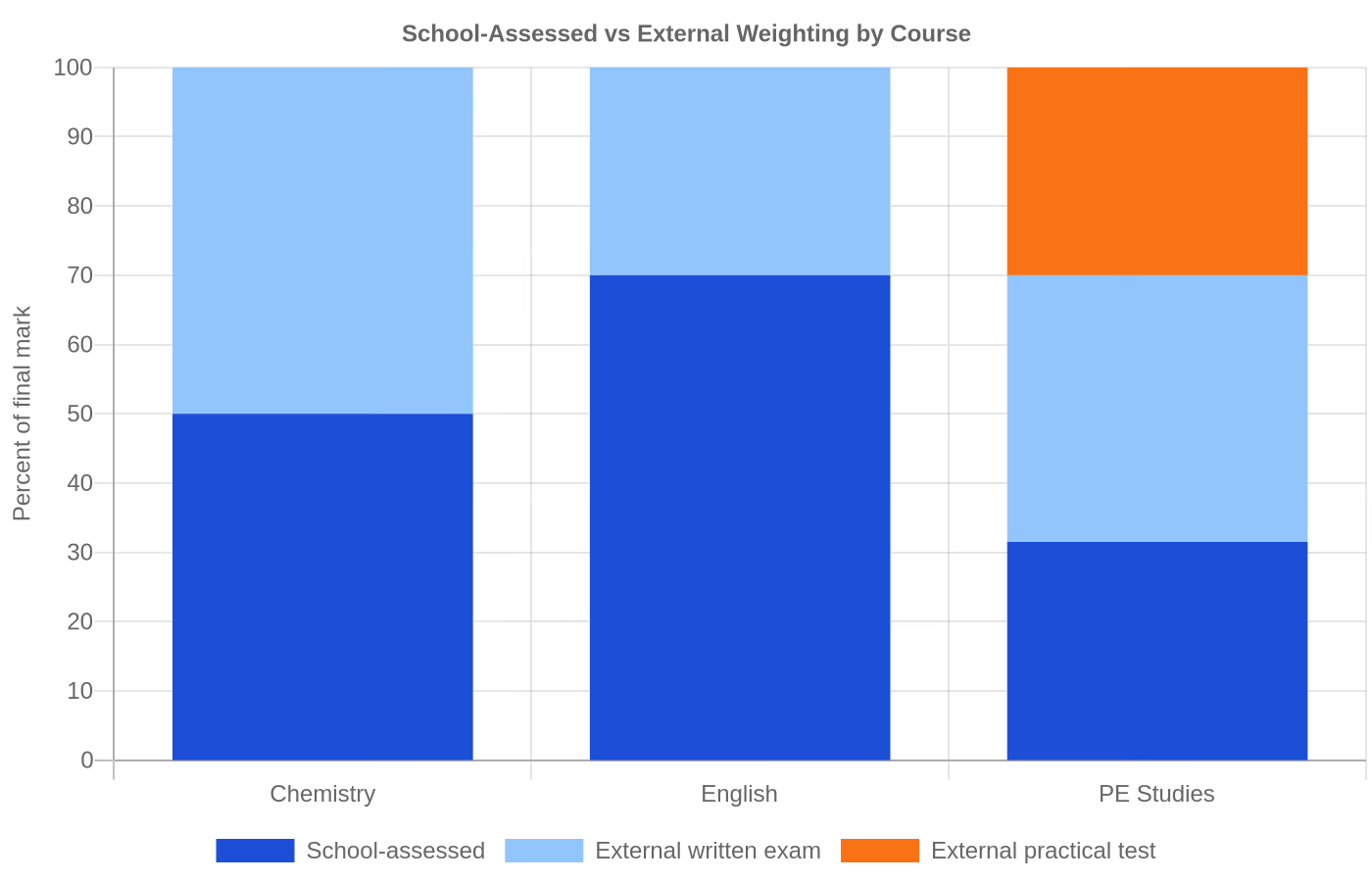
School-assessed versus external weighting by course, comparing Chemistry, English and PE Studies as a stacked bar chart
Source: SCSA Year 12 ATAR syllabi, 2024–2025.

Teacher marking exam papers with a red pen at a desk
Every school also has to submit a formal assessment outline for each course, listing every task, its weighting and roughly when it happens across the year. SCSA requires each listed assessment type, tests, investigations, oral tasks, whatever the syllabus specifies, to appear at least once per year. Isn't it reassuring to know there's a floor on how varied your child's assessment actually has to be?
Browse our WACE subject guides to check the specific assessment structure for each of your child's courses.
How Does Consensus Moderation Work?
Consensus moderation is SCSA's process for aligning marking standards before school marks are even finalised. Teachers from different schools compare a sample of student work, typically a low-A, low-B and low-C file, against shared grade descriptions in structured full-day meetings (SCSA Consensus Moderation, 2026). It happens in Semester 1, well before final marks are due.
Not every course goes through this every year. For 2026, SCSA has nominated courses including Drama, Media Production and Analysis, Economics, Geography, Psychology and Computer Science for consensus moderation (SCSA, 2026). Schools teaching a listed course are required to participate.
What this actually fixes: Two students could submit near-identical essays at two different schools and, without moderation, get different grades simply because their teachers judged the same standard differently. Consensus moderation exists specifically to close that gap before it reaches your child's final mark.
How Does Statistical Moderation Adjust School Marks?
Statistical moderation places a school's moderated marks "on the same scale as the ATAR course examination marks at the school for that course," and critically, a student's rank stays identical whether their school's marks move up or down (SCSA, Explanation of How School Marks and Examination Marks Are Used, 2017/8603v2). SCSA isn't averaging two numbers. It's recalibrating a whole school's mark distribution.
In plain terms: if a school's students score higher on the external exam than their internal marks suggested, SCSA shifts that school's assessed marks upward to match, and shifts them down if the reverse happens. What never changes is each student's position relative to their own classmates. The top-ranked Chemistry student at a given school stays the top-ranked Chemistry student at that school, regardless of which direction the scaling moves.

Teacher presenting to students in a classroom
SCSA's own methodology document states that moderated school marks are rescaled to match a school's exam-mark distribution for that course, while preserving each student's rank within their school regardless of whether the adjustment moves marks up or down. The combined score is then built from the moderated school mark and the exam mark together, not either figure alone.
Why Might My Child's Mark Move?
A reported school mark can differ from what a teacher originally calculated, and that's statistical moderation doing its job, not an error (SCSA, 2017/8603v2). Because the process only rescales the distribution, not individual rankings, a student's mark can move without anyone else's relative standing changing around them.
That distinction matters most for two groups of parents: those worried a high-performing school will "cap" their child's mark, and those worried a struggling school will drag it down. Neither concern holds up against the mechanism itself. Your child's mark can shift with the scale, but their position among their own classmates cannot.
Want a clearer picture of exactly where your child's school marks stand before moderation? Apply for tutoring with Apex Tuition Australia and we'll help you track progress against each assessment task through the year.
Frequently Asked Questions
Is school assessment always worth 50% of the final mark?
No. It depends entirely on the course. Chemistry ATAR splits 50/50 with the exam, English ATAR weights school assessment at 70%, and PE Studies combines a 70% written component with a separate 30% practical test (SCSA Year 12 syllabi, 2024–2025). Check each course's syllabus for its exact split.
What is consensus moderation?
It's SCSA's process for aligning marking standards across schools before final marks are submitted. Teachers compare sample student work against shared grade descriptions in Semester 1 meetings, for a rotating list of nominated courses each year (SCSA Consensus Moderation, 2026).
Does statistical moderation lower my child's rank?
No. SCSA's methodology document confirms that a student's ranking within their school stays identical after statistical moderation, regardless of whether the school's marks are adjusted up or down (SCSA, 2017/8603v2). Only the scale of the marks changes, not each student's relative position.
When are 2026 WACE results released?
SCSA hadn't published the exact 2026 date at the time of writing, but the 2025 cohort received results on Sunday 21 December 2025, and results typically land in mid-to-late December each year (SCSA). Check SCSA's examination calendar closer to the date for the confirmed release.
Conclusion
School-based assessment isn't a single fixed formula. It's a course-specific mix of task types, checked for consistency through consensus moderation, then statistically aligned to exam performance through a process that protects each student's rank at their own school.
Understanding that sequence turns a confusing mark change into something predictable. Your child's WACE mark reflects real work, calibrated fairly against their own classmates, not a lottery of which school they happened to attend.