
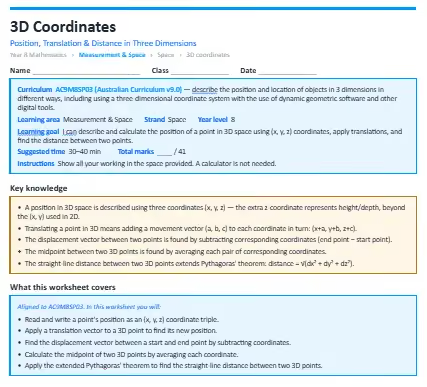
This worksheet introduces 3D coordinates, teaching students to describe a position using (x, y, z), apply translations, and calculate distances between points in three dimensions. The worksheet is split into warm-up questions, standard questions and then extension questions to test you.
The concepts it covers:
- A position in 3D space is described using three coordinates (x, y, z) — the extra z-coordinate represents height/depth, beyond the (x, y) used in 2D.
- Translating a point in 3D means adding a movement vector (a, b, c) to each coordinate in turn: (x+a, y+b, z+c).
- The displacement vector between two points is found by subtracting corresponding coordinates (end point − start point).
- The midpoint between two 3D points is found by averaging each pair of corresponding coordinates.
- The straight-line distance between two 3D points extends Pythagoras' theorem: distance = √(dx² + dy² + dz²).
What your child will practise:
- Reading and write a point's position as an (x, y, z) coordinate triple.
- Applying a translation vector to a 3D point to find its new position.
- Finding the displacement vector between a start and end point by subtracting coordinates.
- Calculating the midpoint of two 3D points by averaging each coordinate.
- Applying the extended Pythagoras' theorem to find the straight-line distance between two 3D points.
Every section opens with a worked example, and the download includes a full answer key with step-by-step solutions and teaching notes on the mistakes students most commonly make.
.webp)


.webp)
%20(1).webp)

