
This worksheet introduces complementary events, teaching students to use the fact that P(A) and P(not A) always sum to one to calculate probabilities in applied contexts. The worksheet is split into warm-up questions, standard questions and then extension questions to test you.
The concepts it covers:
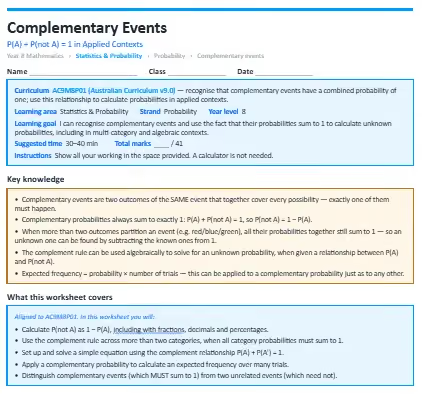
- Complementary events are two outcomes of the same event that together cover every possibility — exactly one of them must happen.
- Complementary probabilities always sum to exactly 1: P(A) + P(not A) = 1, so P(not A) = 1 − P(A).
- When more than two outcomes partition an event (e.g. red/blue/green), all their probabilities together still sum to 1 — so an unknown one can be found by subtracting the known ones from 1.
- The complement rule can be used algebraically to solve for an unknown probability, when given a relationship between P(A) and P(not A).
- Expected frequency = probability × number of trials — this can be applied to a complementary probability just as to any other.
What your child will practise:
- Calculating P(not A) as 1 − P(A), including with fractions, decimals and percentages.
- Using the complement rule across more than two categories, when all category probabilities must sum to 1.
- Seting up and solve a simple equation using the complement relationship P(A) + P(A') = 1.
- Applying a complementary probability to calculate an expected frequency over many trials.
- Distinguishing complementary events (which must sum to 1) from two unrelated events (which need not).
Every section opens with a worked example, and the download includes a full answer key with step-by-step solutions and teaching notes on the mistakes students most commonly make.
.avif)
.webp)


.webp)
%20(1).webp)

