
This worksheet introduces irrational numbers, teaching students to recognise square roots and π as numbers that cannot be written as exact fractions, and to estimate their position on a number line. The worksheet is split into warm-up questions, standard questions and then extension questions to test you.
The concepts it covers:
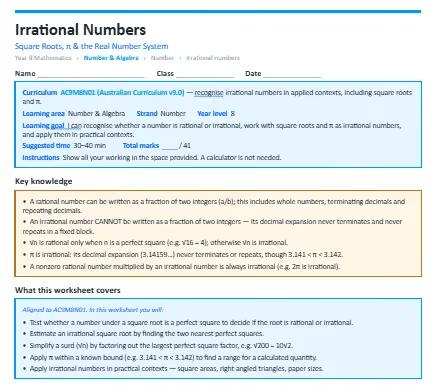
- A rational number can be written as a fraction of two integers (a/b); this includes whole numbers, terminating decimals and repeating decimals.
- An irrational number cannot be written as a fraction of two integers — its decimal expansion never terminates and never repeats in a fixed block.
- √n is rational only when n is a perfect square (e.g. √16 = 4); otherwise √n is irrational.
- π is irrational: its decimal expansion (3.14159…) never terminates or repeats, though 3.141 < π < 3.142.
- A nonzero rational number multiplied by an irrational number is always irrational (e.g. 2π is irrational).
What your child will practise:
- Testing whether a number under a square root is a perfect square to decide if the root is rational or irrational.
- Estimating an irrational square root by finding the two nearest perfect squares.
- Simplifying a surd (√n) by factoring out the largest perfect-square factor, e.g. √200 = 10√2.
- Applying π within a known bound (e.g. 3.141 < π < 3.142) to find a range for a calculated quantity.
- Applying irrational numbers in practical contexts — square areas, right-angled triangles, paper sizes.
Every section opens with a worked example, and the download includes a full answer key with step-by-step solutions and teaching notes on the mistakes students most commonly make.
.webp)


.webp)
%20(1).webp)

