
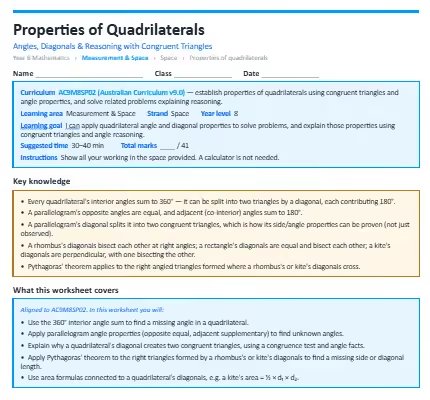
This worksheet builds geometric reasoning, teaching students to apply and explain the angle and diagonal properties of quadrilaterals using congruent triangles. The worksheet is split into warm-up questions, standard questions and then extension questions to test you.
The concepts it covers:
- Every quadrilateral's interior angles sum to 360° — it can be split into two triangles by a diagonal, each contributing 180°.
- A parallelogram's opposite angles are equal, and adjacent (co-interior) angles sum to 180°.
- A parallelogram's diagonal splits it into two congruent triangles, which is how its side/angle properties can be proven (not just observed).
- A rhombus's diagonals bisect each other at right angles; a rectangle's diagonals are equal and bisect each other; a kite's diagonals are perpendicular, with one bisecting the other.
- Pythagoras' theorem applies to the right-angled triangles formed where a rhombus's or kite's diagonals cross.
What your child will practise:
- Using the 360° interior angle sum to find a missing angle in a quadrilateral.
- Applying parallelogram angle properties (opposite equal, adjacent supplementary) to find unknown angles.
- Explaining why a quadrilateral's diagonal creates two congruent triangles, using a congruence test and angle facts.
- Applying Pythagoras' theorem to the right triangles formed by a rhombus's or kite's diagonals to find a missing side or diagonal length.
- Using area formulas connected to a quadrilateral's diagonals, e.g. a kite's area = ½ × d₁ × d₂.
Every section opens with a worked example, and the download includes a full answer key with step-by-step solutions and teaching notes on the mistakes students most commonly make.
.webp)


.webp)
%20(1).webp)

