
This worksheet introduces Pythagoras' theorem, teaching students to find a missing side length in a right-angled triangle and test whether a triangle is right-angled. The worksheet is split into warm-up questions, standard questions and then extension questions to test you.
The concepts it covers:
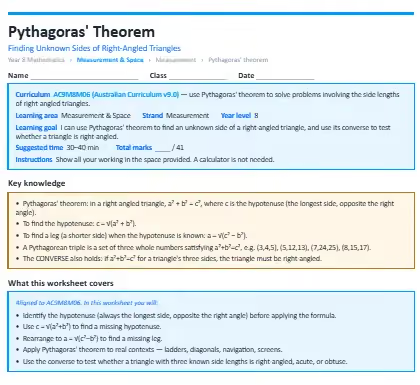
- Pythagoras' theorem: in a right-angled triangle, a² + b² = c², where c is the hypotenuse (the longest side, opposite the right angle).
- To find the hypotenuse: c = √(a² + b²).
- To find a leg (a shorter side) when the hypotenuse is known: a = √(c² − b²).
- A Pythagorean triple is a set of three whole numbers satisfying a²+b²=c², e.g. (3,4,5), (5,12,13), (7,24,25), (8,15,17).
- The converse also holds: if a²+b²=c² for a triangle's three sides, the triangle must be right-angled.
What your child will practise:
- Identifying the hypotenuse (always the longest side, opposite the right angle) before applying the formula.
- Using c = √(a²+b²) to find a missing hypotenuse.
- Rearranging to a = √(c²−b²) to find a missing leg.
- Applying Pythagoras' theorem to real contexts — ladders, diagonals, navigation, screens.
- Using the converse to test whether a triangle with three known side lengths is right-angled, acute, or obtuse.
Every section opens with a worked example, and the download includes a full answer key with step-by-step solutions and teaching notes on the mistakes students most commonly make.
.webp)


.webp)
%20(1).webp)

