
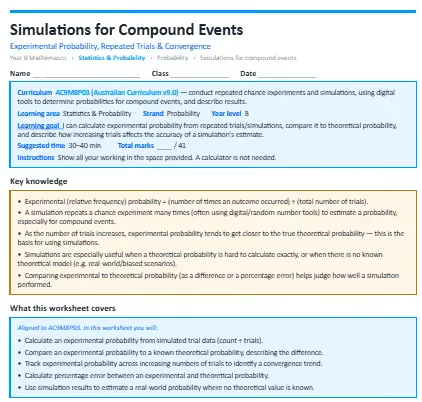
This worksheet builds understanding of chance, teaching students to calculate experimental probability from a simulation's repeated trials and compare it with the theoretical probability. The worksheet is split into warm-up questions, standard questions and then extension questions to test you.
The concepts it covers:
- Experimental (relative frequency) probability = (number of times an outcome occurred) ÷ (total number of trials).
- A simulation repeats a chance experiment many times (often using digital/random-number tools) to estimate a probability, especially for compound events.
- As the number of trials increases, experimental probability tends to get closer to the true theoretical probability — this is the basis for using simulations.
- Simulations are especially useful when a theoretical probability is hard to calculate exactly, or when there is no known theoretical model (e.g. real-world/biased scenarios).
- Comparing experimental to theoretical probability (as a difference or a percentage error) helps judge how well a simulation performed.
What your child will practise:
- Calculating an experimental probability from simulated trial data (count ÷ trials).
- Comparing an experimental probability to a known theoretical probability, describing the difference.
- Tracking experimental probability across increasing numbers of trials to identify a convergence trend.
- Calculating percentage error between an experimental and theoretical probability.
- Using simulation results to estimate a real-world probability where no theoretical value is known.
Every section opens with a worked example, and the download includes a full answer key with step-by-step solutions and teaching notes on the mistakes students most commonly make.
.avif)
.webp)


.webp)
%20(1).webp)

