
This worksheet strengthens number sense, teaching students to convert fractions to decimals and recognise which fractions produce terminating decimals and which produce recurring decimals. The worksheet is split into warm-up questions, standard questions and then extension questions to test you.
The concepts it covers:
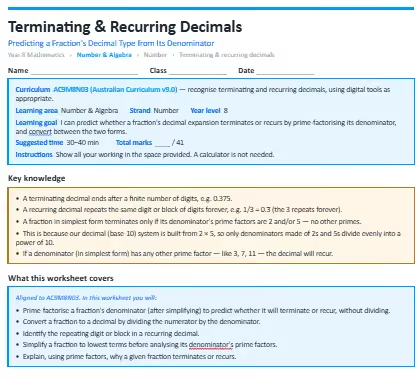
- A terminating decimal ends after a finite number of digits, e.g. 0.375.
- A recurring decimal repeats the same digit or block of digits forever, e.g. 1/3 = 0.3̅ (the 3 repeats forever).
- A fraction in simplest form terminates only if its denominator's prime factors are 2 and/or 5 — no other primes.
- This is because our decimal (base-10) system is built from 2 × 5, so only denominators made of 2s and 5s divide evenly into a power of 10.
- If a denominator (in simplest form) has any other prime factor — like 3, 7, 11 — the decimal will recur.
What your child will practise:
- Prime-factorising a fraction's denominator (after simplifying) to predict whether it will terminate or recur, without dividing.
- Converting a fraction to a decimal by dividing the numerator by the denominator.
- Identifying the repeating digit or block in a recurring decimal.
- Simplifying a fraction to lowest terms before analysing its denominator's prime factors.
- Explain,ing using prime factors, why a given fraction terminates or recurs.
Every section opens with a worked example, and the download includes a full answer key with step-by-step solutions and teaching notes on the mistakes students most commonly make.
.webp)


.webp)
%20(1).webp)

