
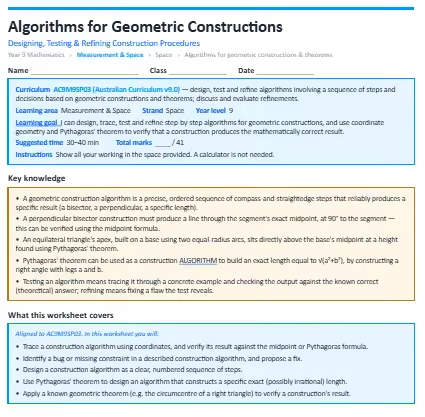
This worksheet builds computational thinking, teaching students to design, test and refine step-by-step algorithms for geometric constructions, verified using coordinate geometry and Pythagoras' theorem. The worksheet is split into warm-up questions, standard questions and then extension questions to test you.
The concepts it covers:
- A geometric construction algorithm is a precise, ordered sequence of compass-and-straightedge steps that reliably produces a specific result (a bisector, a perpendicular, a specific length).
- A perpendicular bisector construction must produce a line through the segment's exact midpoint, at 90° to the segment — this can be verified using the midpoint formula.
- An equilateral triangle's apex, built on a base using two equal-radius arcs, sits directly above the base's midpoint at a height found using Pythagoras' theorem.
- Pythagoras' theorem can be used as a construction algorithm to build an exact length equal to √(a²+b²), by constructing a right angle with legs a and b.
- Testing an algorithm means tracing it through a concrete example and checking the output against the known correct (theoretical) answer; refining means fixing a flaw the test reveals.
What your child will practise:
- Tracing a construction algorithm using coordinates, and verify its result against the midpoint or Pythagoras formula.
- Identifying a bug or missing constraint in a described construction algorithm, and propose a fix.
- Designing a construction algorithm as a clear, numbered sequence of steps.
- Using Pythagoras' theorem to design an algorithm that constructs a specific exact (possibly irrational) length.
- Applying a known geometric theorem (e.g. the circumcentre of a right triangle) to verify a construction's result.
Every section opens with a worked example, and the download includes a full answer key with step-by-step solutions and teaching notes on the mistakes students most commonly make.
.webp)


.webp)
%20(1).webp)

