
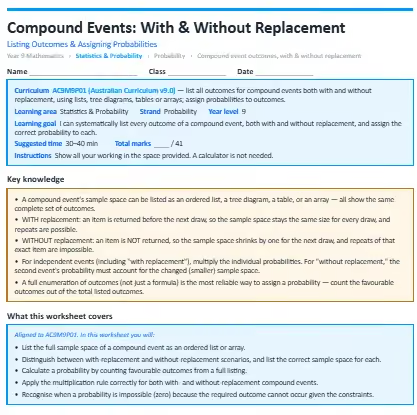
This worksheet teaches students to systematically list every outcome of a compound event, both with and without replacement, and assign the correct probability to each. The worksheet is split into warm-up questions, standard questions and then extension questions to test you.
The concepts it covers:
- A compound event's sample space can be listed as an ordered list, a tree diagram, a table, or an array — all show the same complete set of outcomes.
- with replacement: an item is returned before the next draw, so the sample space stays the same size for every draw, and repeats are possible.
- without replacement: an item is not returned, so the sample space shrinks by one for the next draw, and repeats of that exact item are impossible.
- For independent events (including "with replacement"), multiply the individual probabilities. For "without replacement," the second event's probability must account for the changed (smaller) sample space.
- A full enumeration of outcomes (not just a formula) is the most reliable way to assign a probability — count the favourable outcomes out of the total listed outcomes.
What your child will practise:
- Listing the full sample space of a compound event as an ordered list or array.
- Distinguishing between with-replacement and without-replacement scenarios, and list the correct sample space for each.
- Calculating a probability by counting favourable outcomes from a full listing.
- Applying the multiplication rule correctly for both with- and without-replacement compound events.
- Recognising when a probability is impossible (zero) because the required outcome cannot occur given the constraints.
Every section opens with a worked example, and the download includes a full answer key with step-by-step solutions and teaching notes on the mistakes students most commonly make.
.webp)


.webp)
%20(1).webp)

