
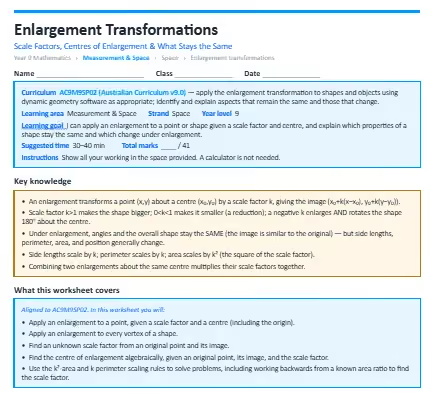
This worksheet introduces enlargement transformations, teaching students to apply a scale factor and centre to a shape, and explain which properties stay the same and which change. The worksheet is split into warm-up questions, standard questions and then extension questions to test you.
The concepts it covers:
- An enlargement transforms a point (x,y) about a centre (x₀,y₀) by a scale factor k, giving the image (x₀+k(x−x₀), y₀+k(y−y₀)).
- Scale factor k>1 makes the shape bigger; 0<k<1 makes it smaller (a reduction); a negative k enlarges and rotates the shape 180° about the centre.
- Under enlargement, angles and the overall shape stay the same (the image is similar to the original) — but side lengths, perimeter, area, and position generally change.
- Side lengths scale by k; perimeter scales by k; area scales by k² (the square of the scale factor).
- Combining two enlargements about the same centre multiplies their scale factors together.
What your child will practise:
- Applying an enlargement to a point, given a scale factor and a centre (including the origin).
- Applying an enlargement to every vertex of a shape.
- Finding an unknown scale factor from an original point and its image.
- Finding the centre of enlargement algebraically, given an original point, its image, and the scale factor.
- Using the k²-area and k-perimeter scaling rules to solve problems, including working backwards from a known area ratio to find the scale factor.
Every section opens with a worked example, and the download includes a full answer key with step-by-step solutions and teaching notes on the mistakes students most commonly make.
.webp)


.webp)
%20(1).webp)

