
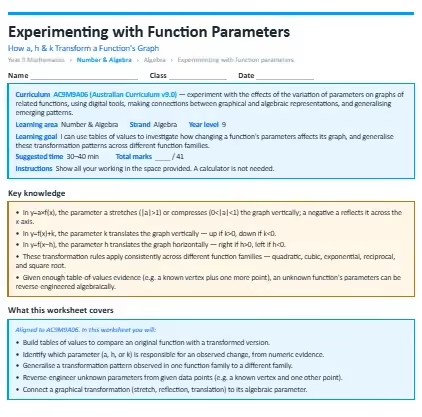
This worksheet builds understanding of function transformations, teaching students to use tables of values to investigate how changing a function's parameters affects its graph. The worksheet is split into warm-up questions, standard questions and then extension questions to test you.
The concepts it covers:
- In y=a×f(x), the parameter a stretches (|a|>1) or compresses (0<|a|<1) the graph vertically; a negative a reflects it across the x-axis.
- In y=f(x)+k, the parameter k translates the graph vertically — up if k>0, down if k<0.
- In y=f(x−h), the parameter h translates the graph horizontally — right if h>0, left if h<0.
- These transformation rules apply consistently across different function families — quadratic, cubic, exponential, reciprocal, and square root.
- Given enough table-of-values evidence (e.g. a known vertex plus one more point), an unknown function's parameters can be reverse-engineered algebraically.
What your child will practise:
- Building tables of values to compare an original function with a transformed version.
- Identifying which parameter (a, h, or k) is responsible for an observed change, from numeric evidence.
- Generalising a transformation pattern observed in one function family to a different family.
- Reverse-engineering unknown parameters from given data points (e.g. a known vertex and one other point).
- Connecting a graphical transformation (stretch, reflection, translation) to its algebraic parameter.
Every section opens with a worked example, and the download includes a full answer key with step-by-step solutions and teaching notes on the mistakes students most commonly make.
.webp)


.webp)
%20(1).webp)

