
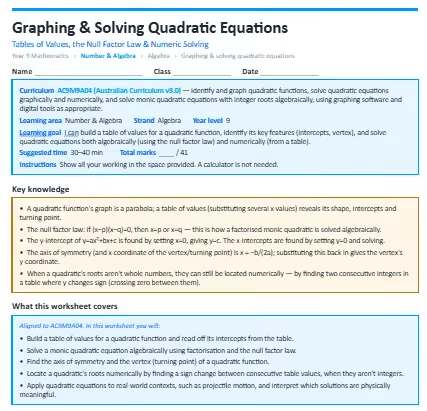
This worksheet introduces quadratic functions, teaching students to build a table of values, identify key features, and solve quadratic equations both algebraically and numerically. The worksheet is split into warm-up questions, standard questions and then extension questions to test you.
The concepts it covers:
- A quadratic function's graph is a parabola; a table of values (substituting several x-values) reveals its shape, intercepts and turning point.
- The null factor law: if (x−p)(x−q)=0, then x=p or x=q — this is how a factorised monic quadratic is solved algebraically.
- The y-intercept of y=ax²+bx+c is found by setting x=0, giving y=c. The x-intercepts are found by setting y=0 and solving.
- The axis of symmetry (and x-coordinate of the vertex/turning point) is x = −b/(2a); substituting this back in gives the vertex's y-coordinate.
- When a quadratic's roots aren't whole numbers, they can still be located numerically — by finding two consecutive integers in a table where y changes sign (crossing zero between them).
What your child will practise:
- Building a table of values for a quadratic function and read off its intercepts from the table.
- Solving a monic quadratic equation algebraically using factorisation and the null factor law.
- Finding the axis of symmetry and the vertex (turning point) of a quadratic function.
- Locating a quadratic's roots numerically by finding a sign change between consecutive table values, when they aren't integers.
- Applying quadratic equations to real-world contexts, such as projectile motion, and interpret which solutions are physically meaningful.
Every section opens with a worked example, and the download includes a full answer key with step-by-step solutions and teaching notes on the mistakes students most commonly make.
.webp)


.webp)
%20(1).webp)

