
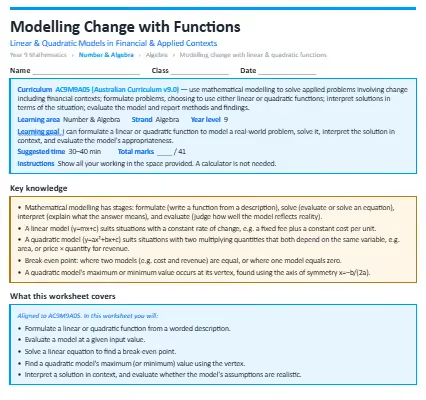
This worksheet applies linear and quadratic functions to real-world modelling problems, requiring students to formulate, solve, interpret and evaluate a mathematical model. The worksheet is split into warm-up questions, standard questions and then extension questions to test you.
The concepts it covers:
- Mathematical modelling has stages: formulate (write a function from a description), solve (evaluate or solve an equation), interpret (explain what the answer means), and evaluate (judge how well the model reflects reality).
- A linear model (y=mx+c) suits situations with a constant rate of change, e.g. a fixed fee plus a constant cost per unit.
- A quadratic model (y=ax²+bx+c) suits situations with two multiplying quantities that both depend on the same variable, e.g. area, or price × quantity for revenue.
- Break-even point: where two models (e.g. cost and revenue) are equal, or where one model equals zero.
- A quadratic model's maximum or minimum value occurs at its vertex, found using the axis of symmetry x=−b/(2a).
What your child will practise:
- Formulating a linear or quadratic function from a worded description.
- Evaluating a model at a given input value.
- Solving a linear equation to find a break-even point.
- Finding a quadratic model's maximum (or minimum) value using the vertex.
- Interpreting a solution in context, and evaluate whether the model's assumptions are realistic.
Every section opens with a worked example, and the download includes a full answer key with step-by-step solutions and teaching notes on the mistakes students most commonly make.
.webp)


.webp)
%20(1).webp)

