
This worksheet teaches students to analyse how sampling method and choice of graph representation — including misleading truncated axes — can distort or support a particular point of view. The worksheet is split into warm-up questions, standard questions and then extension questions to test you.
The concepts it covers:
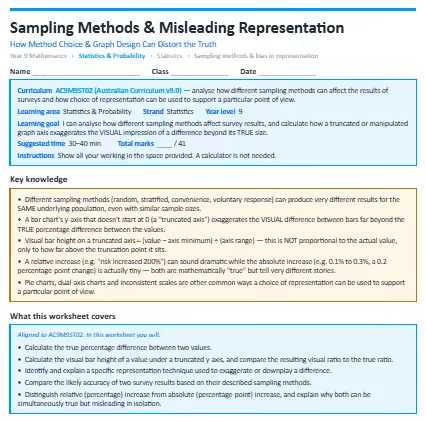
- Different sampling methods (random, stratified, convenience, voluntary response) can produce very different results for the same underlying population, even with similar sample sizes.
- A bar chart's y-axis that doesn't start at 0 (a "truncated axis") exaggerates the visual difference between bars far beyond the true percentage difference between the values.
- Visual bar height on a truncated axis = (value − axis minimum) ÷ (axis range) — this is not proportional to the actual value, only to how far above the truncation point it sits.
- A relative increase (e.g. "risk increased 200%") can sound dramatic while the absolute increase (e.g. 0.1% to 0.3%, a 0.2 percentage-point change) is actually tiny — both are mathematically "true" but tell very different stories.
- Pie charts, dual-axis charts and inconsistent scales are other common ways a choice of representation can be used to support a particular point of view.
What your child will practise:
- Calculating the true percentage difference between two values.
- Calculating the visual bar height of a value under a truncated y-axis, and compare the resulting visual ratio to the true ratio.
- Identifying and explain a specific representation technique used to exaggerate or downplay a difference.
- Comparing the likely accuracy of two survey results based on their described sampling methods.
- Distinguishing relative (percentage) increase from absolute (percentage-point) increase, and explain why both can be simultaneously true but misleading in isolation.
Every section opens with a worked example, and the download includes a full answer key with step-by-step solutions and teaching notes on the mistakes students most commonly make.
.webp)


.webp)
%20(1).webp)

