
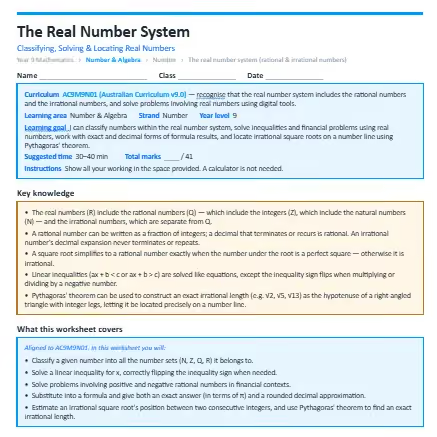
This worksheet introduces the real number system, teaching students to classify numbers as rational or irrational, solve linear inequalities, and locate irrational lengths on a number line using Pythagoras' theorem. The worksheet is split into warm-up questions, standard questions and then extension questions to test you.
The concepts it covers:
- The real numbers (R) include the rational numbers (Q) — which include the integers (Z), which include the natural numbers (N) — and the irrational numbers, which are separate from Q.
- A rational number can be written as a fraction of integers; a decimal that terminates or recurs is rational. An irrational number's decimal expansion never terminates or repeats.
- A square root simplifies to a rational number exactly when the number under the root is a perfect square — otherwise it is irrational.
- Linear inequalities (ax + b < c or ax + b > c) are solved like equations, except the inequality sign flips when multiplying or dividing by a negative number.
- Pythagoras' theorem can be used to construct an exact irrational length (e.g. √2, √5, √13) as the hypotenuse of a right-angled triangle with integer legs, letting it be located precisely on a number line.
What your child will practise:
- Classifying a given number into all the number sets (N, Z, Q, R) it belongs to.
- Solving a linear inequality for x, correctly flipping the inequality sign when needed.
- Solving problems involving positive and negative rational numbers in financial contexts.
- Substituting into a formula and give both an exact answer (in terms of π) and a rounded decimal approximation.
- Estimating an irrational square root's position between two consecutive integers, and use Pythagoras' theorem to find an exact irrational length.
Every section opens with a worked example, and the download includes a full answer key with step-by-step solutions and teaching notes on the mistakes students most commonly make.
.webp)


.webp)
%20(1).webp)

