
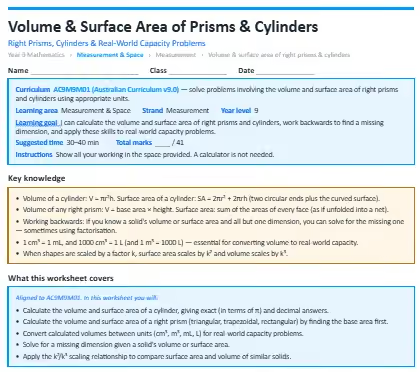
This worksheet extends volume and surface area skills to cylinders and general right prisms, including real-world capacity problems. The worksheet is split into warm-up questions, standard questions and then extension questions to test you.
The concepts it covers:
- Volume of a cylinder: V = πr²h. Surface area of a cylinder: sa = 2πr² + 2πrh (two circular ends plus the curved surface).
- Volume of any right prism: V = base area × height. Surface area: sum of the areas of every face (as if unfolded into a net).
- Working backwards: if you know a solid's volume or surface area and all but one dimension, you can solve for the missing one — sometimes using factorisation.
- 1 cm³ = 1 mL, and 1000 cm³ = 1 L (and 1 m³ = 1000 L) — essential for converting volume to real-world capacity.
- When shapes are scaled by a factor k, surface area scales by k² and volume scales by k³.
What your child will practise:
- Calculating the volume and surface area of a cylinder, giving exact (in terms of π) and decimal answers.
- Calculating the volume and surface area of a right prism (triangular, trapezoidal, rectangular) by finding the base area first.
- Converting calculated volumes between units (cm³, m³, mL, L) for real-world capacity problems.
- Solving for a missing dimension given a solid's volume or surface area.
- Applying the k²/k³ scaling relationship to compare surface area and volume of similar solids.
Every section opens with a worked example, and the download includes a full answer key with step-by-step solutions and teaching notes on the mistakes students most commonly make.

.webp)


.webp)
%20(1).webp)

