


VCE Legal Studies explores the foundations of Australia’s legal system and the processes by which laws are made, applied, and upheld. It examines the institutions and principles that underpin our justice system, including the roles of courts, parliament, and the Constitution. Students learn about the rights of individuals, the responsibilities of lawmakers, and the mechanisms designed to achieve fairness and justice in society.
Why study VCE Legal Studies?
VCE Legal Studies is one of the most dynamic and relevant humanities subjects, offering students a real-world understanding of how Australia’s legal system operates and adapts to social change. It helps students make sense of current legal issues—such as criminal trials, constitutional debates, and law reform—while developing skills in reasoning, evaluation, and analysis.
Academic and University Pathways
- Legal Studies provides an excellent foundation for tertiary courses in law, criminology, political science, international relations, and public policy.
- The subject builds essential skills in critical thinking, analytical writing, and research, which are valued across humanities, business, and legal degrees.
- Students gain confidence interpreting complex information, evaluating evidence, and constructing reasoned arguments—all key skills for university success.
💡Legal Studies also pairs well with other humanities subjects. For inspiration, you can read student stories like how I scored a 46 in VCE Global Politics and how I scored a 50 in VCE English.
Career and Life Skills
- Legal Studies cultivates civic awareness, helping students understand their rights and responsibilities as citizens.
- It encourages informed participation in democratic processes, from voting to engaging in debates on social justice.
- Beyond careers in law or government, the subject fosters transferable skills—such as communication, problem-solving, and ethical reasoning—relevant in business, journalism, and education.
What topics are covered in VCE Legal Studies?
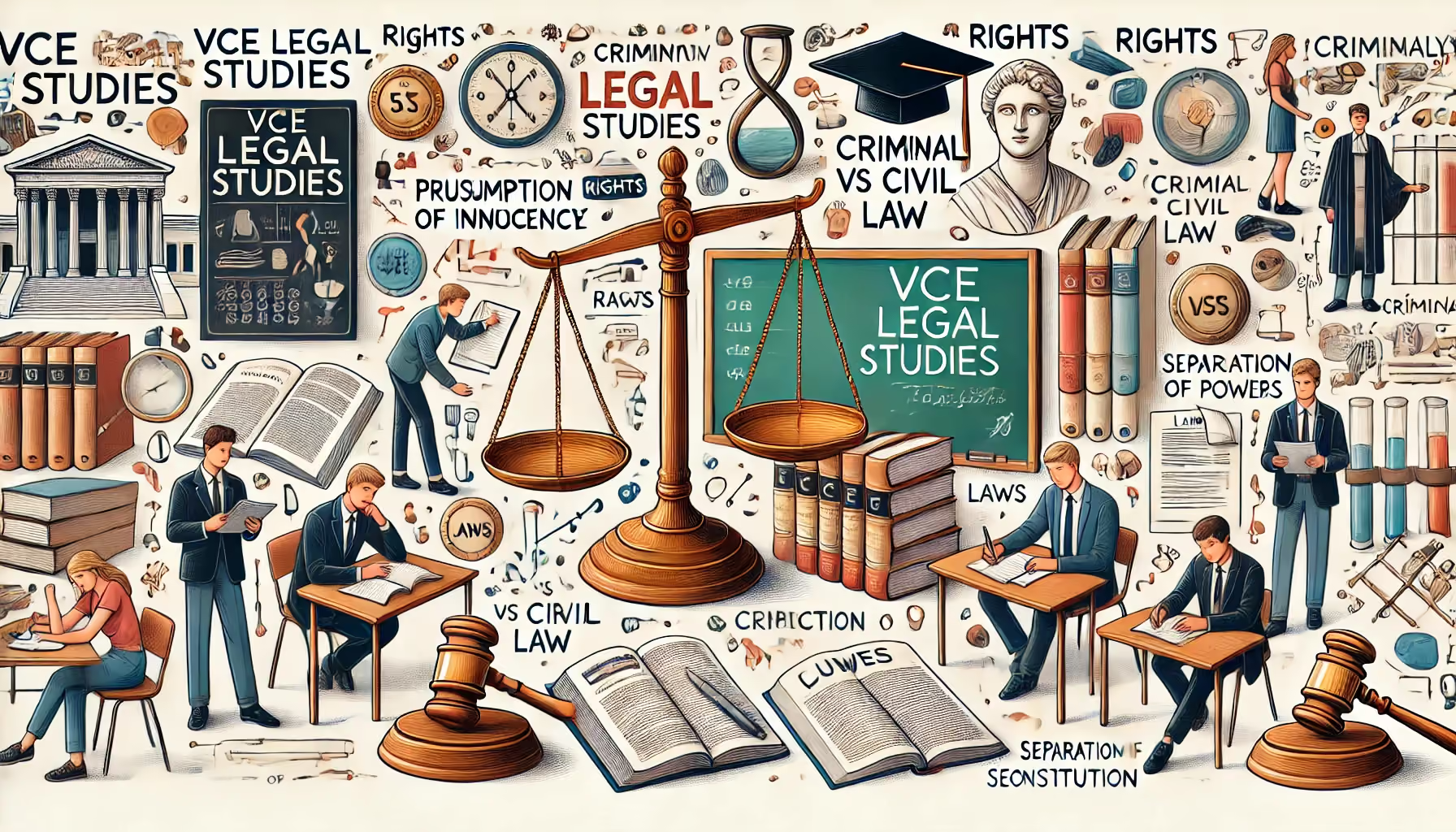
VCE Legal Studies is divided into four key units, each designed to explore a different aspect of the legal system—from its foundations to its future reforms.
Unit 1: The Presumption of Innocence
- Introduces students to the principles and purposes of law in society, including the role of criminal law in achieving social cohesion and protecting individual rights.
- Students learn about legal foundations, types and sources of law, the distinction between criminal and civil law, and the characteristics of an effective law.
- The unit examines the criminal justice system in Victoria, including the roles of courts, juries, and sanctions, and explores how justice principles such as fairness, equality, and access are upheld in practice.
Unit 2: Wrongs and Rights
- Focuses on civil law, which protects individual rights and provides mechanisms for resolving disputes.
- Students study key concepts like liability, negligence, and defamation, analysing how civil disputes are resolved through courts and alternative dispute resolution.
- The unit also covers human rights in Australia, including how they are protected and potential reforms to strengthen those protections.
- Students investigate a contemporary Australian human rights issue through a detailed case study.
Unit 3: Rights and Justice
- Builds on earlier units by exploring how the Victorian and Commonwealth justice systems uphold the principles of justice.
- Students examine the roles of courts, parliament, and the Constitution in law-making and rights protection.
- The unit also analyses criminal and civil procedures, the ability of institutions to achieve justice, and the relationship between statutory interpretation and common law.
Unit 4: The People, the Law and Reform
- Examines how individuals, media, and law reform bodies influence the legal system and drive change.
- Students evaluate the effectiveness of law reform, exploring recent case studies and constitutional changes.
- The unit also looks at the roles of parliament and the High Court in shaping Australian law, including landmark constitutional cases and referendums.
Across these four units, students gain a deep understanding of both criminal and civil law, while developing the ability to analyse legal systems, evaluate reforms, and apply reasoning to real-world legal issues.
How is VCE Legal Studies assessed?
Assessment in VCE Legal Studies is divided between School-assessed Coursework (SACs) and an end-of-year examination. These components are designed to evaluate both theoretical understanding and the ability to apply legal principles to real and hypothetical scenarios.
Assessment Breakdown
- Unit 3 School-assessed Coursework (SACs): 25%
- Unit 4 School-assessed Coursework (SACs): 25%
- End-of-year examination: 50%
💡Students can plan their study year around the key dates using the VCE exam timetable 2025, and see how Legal Studies performs in context using the VCE Scaling Report 2025.
School-Assessed Coursework (SACs)
Each unit includes two outcomes, assessed through a combination of written tasks such as:
- Case studies
- Structured questions
- Essays
- Reports
- Folios of exercises
Unit 3: Rights and Justice
- Outcome 1: Explain the key principles in the criminal justice system, evaluate sanctions, and assess how effectively justice is achieved in criminal cases. (50 marks)
- Outcome 2: Explain the key principles in the civil justice system, evaluate remedies, and assess the ability of the system to achieve fairness, equality, and access. (50 marks)
- 📊 Total: 100 marks, contributing 25% of the study score
Unit 4: The People, the Law and Reform
- Outcome 1: Discuss the ability of parliament and courts to make law and evaluate how the Constitution acts as a check on parliamentary law-making. (60 marks)
- Outcome 2: Evaluate law reform processes and discuss the roles of individuals, media, and law reform bodies in driving change. (40 marks)
- 📊 Total: 100 marks, contributing 25% of the study score
End-of-Year Examination
- Contribution: 50% of the final study score
- Duration: 2 hours
- Format: Combination of short-answer, extended-response, and application-based questions covering all key knowledge and skills from Units 3 and 4.
- Focus: Students must analyse scenarios, apply legal reasoning, and evaluate the effectiveness of the justice system.
Examiners look for clarity, precision, and evaluation—students should define legal terms accurately, link theory to current examples, and demonstrate insight into how the law achieves fairness, equality, and access.
A strong foundation in writing from subjects like VCE English or VCE English Language can also be an advantage.
What skills or capabilities are required to do VCE Legal Studies?
VCE Legal Studies develops a unique blend of analytical, evaluative, and communication skills, combining theory with real-world application. Students who excel in this subject typically demonstrate strong reasoning and attention to detail.
1. Analytical and Critical Thinking Skills
- The ability to interpret and evaluate legal principles, court cases, and law reform examples.
- Assessing the effectiveness of the legal system in achieving fairness, equality, and access.
- Drawing connections between theory and current legal issues or cases.
2. Written Communication and Argumentation
- Writing clear, concise, and well-structured responses that use legal terminology correctly.
- Presenting balanced arguments that consider multiple perspectives.
- Using evidence from case studies and media reports to support points in essays and SACs.
3. Research and Evaluation Skills
- Investigating recent examples of law reform, court decisions, or legislative change.
- Evaluating the roles of parliament, courts, and the Constitution in law-making.
- Using up-to-date examples to strengthen explanations and evaluation.
4. Attention to Detail and Organisation
- Keeping track of definitions, precedents, and case studies.
- Managing time effectively, especially in essay-style SACs and the exam.
Students don’t need prior legal knowledge to succeed—just curiosity, a logical mindset, and the willingness to engage with real-world justice issues.

Tips to Succeed in VCE Legal Studies
VCE Legal Studies rewards students who go beyond memorising facts and instead analyse, evaluate, and apply legal principles to real-world scenarios. Here are practical, subject-specific strategies to help you succeed:
1. Master Legal Terminology and Definitions
- Use the exact wording from the study design when defining key terms like fairness, equality, and access.
- Practise writing definitions in context to ensure you can apply them in SACs and the exam.
2. Link Theory to Real Cases and Examples
- Examiners love responses that reference recent, relevant case studies—for example, High Court cases or recent law reforms.
- Create a case summary bank (e.g. Mabo v Queensland (1992), Dietrich v The Queen (1992)) and learn the facts, principles, and outcomes.
3. Use Evaluation Frameworks
- Evaluation is critical in Legal Studies. For any law, institution, or reform, practise identifying strengths, weaknesses, and reforms.
- Use a structure like: “One strength of [policy/law] is… however, a limitation is…”
4. Develop Strong Written Responses
- Follow a clear structure such as PEEL (Point, Evidence, Explanation, Link) or TEEL for paragraph responses.
- For longer essays, plan your argument before writing to ensure logical flow and balance.
To support your revision habits across all subjects, you can also build a routine using our guide on how to create a study plan that works for you and refine your methods with scientifically proven strategies to improve how you study.
5. Stay Updated with Contemporary Examples
- Follow the ABC, The Guardian, or Parliament of Victoria websites to track current law reforms and cases.
- These examples will make your responses stand out in SACs and the final exam.
6. Practise Application and Analysis Questions
- Use past VCAA exams to refine your ability to apply theory to unseen scenarios.
- Focus on understanding why a legal principle applies—not just what it is.
7. Collaborate and Discuss
- Discussing cases and reforms with classmates or tutors helps reinforce understanding and exposes you to different perspectives.
What are the Most Common Mistakes VCE Legal Studies Students Make?
Even high-achieving students can lose marks in Legal Studies by overlooking key skills the examiners are looking for. Here are the most common pitfalls and how to avoid them:
1. Inaccurate or Incomplete Definitions
- Many students lose easy marks by failing to provide precise legal definitions.
- For instance, saying “fairness means being fair” won’t earn credit—VCAA expects the use of exact terms such as “fairness ensures a fair legal process and hearing where both parties have the opportunity to present their case.”
Learn definitions from the study design word-for-word and practise applying them in context.
2. Weak Evaluation Skills
- Students often describe rather than evaluate legal institutions or reforms.
- Evaluation requires analysis of strengths, weaknesses, and overall effectiveness in achieving fairness, equality, and access.
Use structures like “One strength of this is… however, a limitation is…” followed by a judgement about its effectiveness.
3. Poor Application to Scenarios
- Many SACs and exam questions require applying theory to real or hypothetical cases.
- Generic answers that don’t link to the specific case provided lose marks.
Always tie explanations back to the scenario or example mentioned in the question.
4. Lack of Contemporary Examples
- Outdated or missing examples weaken otherwise strong responses.
- VCAA examiners expect up-to-date references to cases, reforms, or institutions (e.g. a recent High Court case or law reform campaign).
Regularly update your examples and maintain a summary sheet of current reforms and case studies.
5. Overwriting or Poor Time Management
- Some students spend too long on low-mark questions, leaving little time for essays or evaluations.
Allocate time based on mark value and practise writing concise yet complete answers under exam conditions.
6. Ignoring the Command Terms
- Words like “explain,” “evaluate,” “analyse,” and “compare” require different response types.
Learn the meaning of VCAA command terms and tailor your answers to what the question is actually asking. The VCE command terms guide is a great reference here.
Conclusion
VCE Legal Studies is one of the most engaging and relevant humanities subjects, helping students understand how the law operates, adapts, and protects rights within Australia’s democratic system. It builds essential skills in analysis, reasoning, and evaluation—preparing students for tertiary study in law, politics, criminology, or public policy, and for informed participation in civic life.