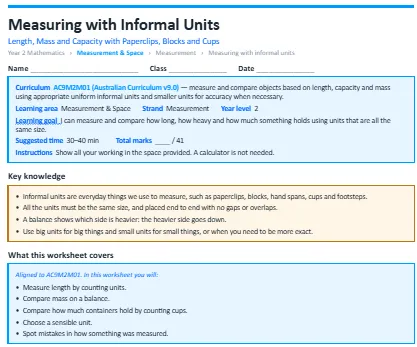
This worksheet teaches students to measure and compare length, mass and capacity with everyday units such as paperclips, blocks, cups and balance scales. The worksheet is split into warm-up questions, standard questions and then extension questions to test you.
The concepts it covers:
- Informal units are everyday things we use to measure, such as paperclips, blocks, hand spans, cups and footsteps.
- All the units must be the same size, and placed end to end with no gaps or overlaps.
- A balance shows which side is heavier: the heavier side goes down.
- Use big units for big things and small units for small things, or when you need to be more exact.
What your child will practise:
- Measuring length by counting units.
- Comparing mass on a balance.
- Comparing how much containers hold by counting cups.
- Choosing a sensible unit.
- Spotting mistakes in how something was measured.
Every section opens with a worked example, and the download includes a full answer key with step-by-step solutions and teaching notes on the mistakes students most commonly make.