

In 2025, about half of Queensland's 57,909 Year 12 students received an ATAR — while the other half earned their Queensland Certificate of Education through Applied subjects, VET qualifications, and other non-ATAR pathways (QCAA, 2025). Both roads lead to a QCE. But they lead to very different places after school.
Choosing between General and Applied subjects is one of the biggest decisions you'll make in Year 10. Get it right and your senior years feel purposeful. Get it wrong and you could find yourself locked out of university entry, or grinding through exam pressure that doesn't suit the way you learn.
This guide explains exactly how each pathway works, so you and your family can make the call with confidence.
📋Key Takeaways
- General subjects contribute to both your QCE and ATAR; Applied subjects contribute to your QCE only (with one exception).
- About half of Queensland's 57,909 Year 12 students in 2025 received an ATAR (QCAA, 2025).
- General subjects include a QCAA external exam; Applied subjects are assessed entirely at school.
- One Applied subject can contribute to an ATAR when paired with four General subjects.
- Most students mix both — you don't have to choose one or the other.
What Are General Subjects in the QCE?
General subjects are the academic foundation of Queensland senior schooling. They combine school-based assessment with a QCAA-set external exam at the end of Year 12, and they're the primary route to an ATAR and university entry.
There are more than 50 General subjects available across every learning area, from English and Literature to Mathematical Methods, Biology, Psychology, Legal Studies, Economics, and Physical Education. Most students planning for university choose four to five General subjects as the core of their program.
Each General subject runs across four units spanning Years 11 and 12:
- Units 1 & 2 (Year 11): Formative. assessed at school, results don't contribute to your ATAR but do count toward QCE credits.
- Units 3 & 4 (Year 12): Summative. results count toward both your QCE and ATAR.
💡Worth knowing: Year 11 General subject results don't affect your ATAR, but they're not meaningless. They determine whether you receive the full four credits for that subject, and a low credit total in Year 11 creates real pressure in Year 12 when you need a buffer.

What Are Applied Subjects in the QCE?
Applied subjects take a more practical approach. They're assessed entirely through school-based work, there's no QCAA external exam — and they're designed for students heading into vocational training, employment, or who simply perform better without a high-stakes final exam.
Applied subjects include Essential English and Essential Mathematics — the two most common choices — alongside options like Sport & Recreation, Early Childhood Studies, Hospitality Practices, Building & Construction Skills, and Visual Arts in Practice.
Like General subjects, each Applied subject runs across four units and can contribute up to four credits toward your QCE. The key difference: all assessment is school-based. Four internal assessment tasks across the course, marked by your teachers against QCAA standards. No external exam, no state-wide sitting period.
🏫Our experience with Brisbane students: Students who switch from General to Applied mid-year often do so because the external exam pressure isn't right for them, not because the content is too hard. Applied subjects aren't "easier." They're differently demanding. The workload spreads across the year, and you can't rely on a strong final exam to lift a weak internal result.
How Assessment Works: General vs Applied
Assessment structure is where the two pathways really diverge, and understanding this is critical before you lock in your subject choices.

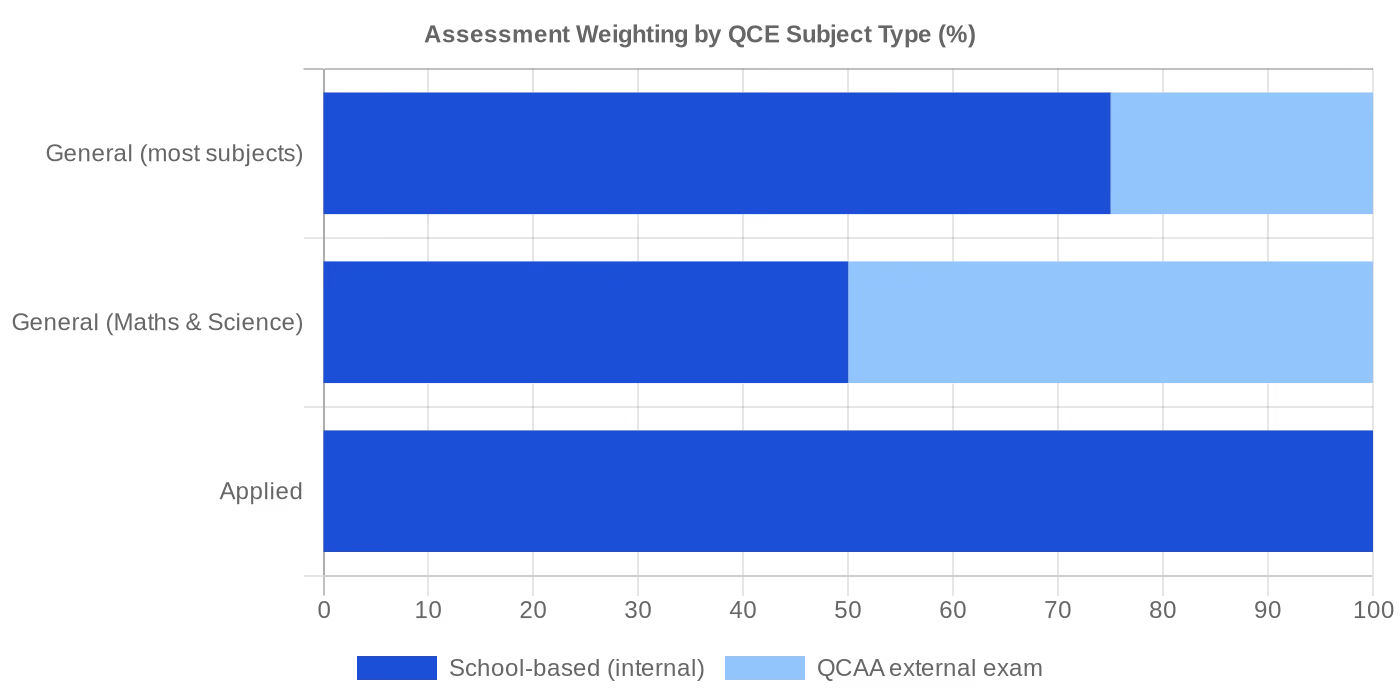
General subjects:
- 75% internal / 25% external for most subjects
- 50% internal / 50% external for Maths subjects (Mathematical Methods, Specialist Mathematics, General Mathematics) and most Sciences (Biology, Chemistry, Physics)
- External exams are set and marked by QCAA, not your school
Applied subjects:
- 100% internal — four tasks across the subject, assessed by your teachers
- No external exam
- Results appear on your Senior Statement but don't contribute to an ATAR by default
How General and Applied Subjects Affect Your ATAR
Here's the critical distinction most students don't fully understand until it's too late. Your ATAR is calculated from your five best General subject results in Year 12. Applied subjects are excluded by default.
The exception: one Applied subject can be included in your ATAR calculation when paired with four General subjects. If you've studied four General subjects and one Applied subject, all five can contribute. But if you've studied three General and two Applied, only the three General results count toward your ATAR, and you'd need a fifth General result to make up the difference.
In 2025, approximately 30,167 Queensland students, about 52% of the Year 12 cohort, received an ATAR (QCAA, 2025). If university entry is your goal, you'll need a clear majority of General subjects in your program.
If university isn't your current plan, or if you're looking at TAFE, apprenticeships, or direct employment, a program built around Applied subjects still earns you a full QCE and prepares you for those pathways just as effectively.
Can You Mix General and Applied Subjects?
Yes — and most students do. There's no requirement to go all-in on one type. A balanced program might look like:
- Four General subjects (e.g., English, General Mathematics, Modern History, Business)
- One Applied subject (e.g., Essential Mathematics or Sport & Recreation)
- Plus a VET qualification alongside
This gives you ATAR eligibility while taking some of the exam pressure off — and still builds 20+ QCE credits comfortably.

💡The timing trap: The choice matters most for keeping options open. If you're unsure about university now but don't want to rule it out, lean toward a General-majority program. You can always decide not to sit the ATAR — but you can't decide to receive one if you haven't studied the General subjects needed to calculate it.
Frequently Asked Questions
Do Applied subjects count toward my QCE?
Yes. Applied subjects contribute up to four credits each toward your QCE, the same as General subjects. You need 20 credits total — with at least 12 from completed Core courses — to earn your QCE (QCAA, 2026). Applied subjects can form part of that count.
Can I switch from General to Applied after Year 11 starts?
Subject changes after Year 11 begins are possible but involve risk — credit carry-over, timing, and assessment deadlines vary by school and subject. Speak to your senior schooling coordinator as early as possible. The sooner you identify a mismatch, the more options you have.
Which Applied subjects are most common in Queensland?
Essential English and Essential Mathematics are the most widely enrolled Applied subjects, particularly among students on VET pathways or those who find the external exam component of General English or General Mathematics a poor fit for how they perform.
Is a General subject always harder than an Applied subject?
Not always. General subjects carry the additional pressure of an external QCAA exam, but the content difficulty varies widely by subject. Some Applied subjects are demanding in their own right — the difference is how you're assessed, not how challenging the material is. Choose based on learning style and goals, not just the subject category.
Conclusion
There's no universally right answer between General and Applied subjects, only the answer that fits your goals, how you learn, and where you want to be after school. General subjects are the path if you're aiming for university entry through an ATAR. Applied subjects offer a fully valid, exam-free QCE pathway for students heading into trades, VET, or direct employment.
The most common mistake? Choosing based on what your friends are doing. Map out your goals for after Year 12, then work backwards to the subject mix that gets you there.
📖 Also reading: How Does the QCE Work? A Complete Guide for Queensland Students, once you know your subject mix, this guide walks through how credits, literacy requirements, and ATAR eligibility all come together in the QCE system.