



In 2025, 57,909 students completed Year 12 in Queensland and just over half, 52%, received an ATAR (QTAC, 2025). For those students, the ATAR is the primary ticket to a university place. But most don't know what score they actually need until they're deep in the QTAC application process, guessing from vague "competitive" descriptions on university websites.
Most undergraduate programs at Queensland universities accept students with ATARs between 60 and 85. Only a small group of high-demand courses, medicine, dentistry, physiotherapy, require scores in the high 90s. This guide gives you real numbers by course type and institution, explains how QTAC adjustment factors can lift your selection rank, and covers the pathways available if your ATAR comes in below what you were hoping for.
📌Key Takeaways
- 52% of Queensland's 57,909 Year 12 graduates received an ATAR in 2025, with 24% scoring 90 or above (QTAC, 2025)
- Most undergraduate programs at QLD universities accept ATARs between 60 and 85 — only medicine, dentistry, and physiotherapy require 95+
- QTAC adjustment factors can add up to 5–10 points to your selection rank, meaning your effective entry score may be higher than your raw ATAR</aside>
How ATAR Entry Into Queensland Universities Actually Works
Selection rank is what Queensland universities use when assessing ATAR applicants, and it isn't always the same as your raw ATAR. Your selection rank equals your ATAR plus any adjustment factors awarded by the university or through QTAC, and it's this combined figure that determines whether you receive an offer (QTAC, 2025). Published cutoff scores aren't predetermined limits, they reflect the lowest selection rank that received an offer in the previous year's round, and they shift with applicant demand each year.
QTAC processes applications for all Queensland public universities. You submit preferences through the QTAC portal, each university assesses your selection rank against available places, and offers go to applicants in rank order until places fill. Courses with fewer places and more applicants have higher cutoffs. Broad programs with more capacity tend to clear lower. Previous-year cutoffs are your best planning guide, but they're a reference point, not a guarantee.
See Top Queensland Schools in 2025 for context on how ATAR results are distributed across the state.
What ATAR Do You Need for Competitive Courses in Queensland?
Medicine, dentistry, and allied health programs carry the highest ATAR thresholds at Queensland universities, with most requiring a selection rank of 91 or above before any additional screening (QTAC, 2025). These programs combine a high ATAR floor with extra requirements, UCAT scores, structured interviews, and in some cases specific subject prerequisites.

Here are the typical minimums for the most competitive Queensland programs:
Medicine
- University of Queensland (provisional school-leaver entry): selection rank approximately 95, plus UCAT
- James Cook University (Bachelor of Medicine, Bachelor of Surgery): selection rank approximately 91–93, plus UCAT
- Griffith University (Doctor of Medicine): graduate entry only — a completed bachelor degree is required, not a school-leaver ATAR
Dentistry
- University of Queensland (Bachelor of Dental Science, Honours): 99.00 guaranteed entry threshold (UQ, 2026)
Physiotherapy
- University of Queensland (Bachelor of Physiotherapy, Honours): the minimum ATAR accepted in 2025 was 98.10 (UQ, 2025)
Law
- University of Queensland (Bachelor of Laws, Honours): typical selection rank of 97.50 or higher (UQ, 2025)
- QUT (Bachelor of Laws): selection rank typically in the high 80s to low 90s (QUT, 2025)
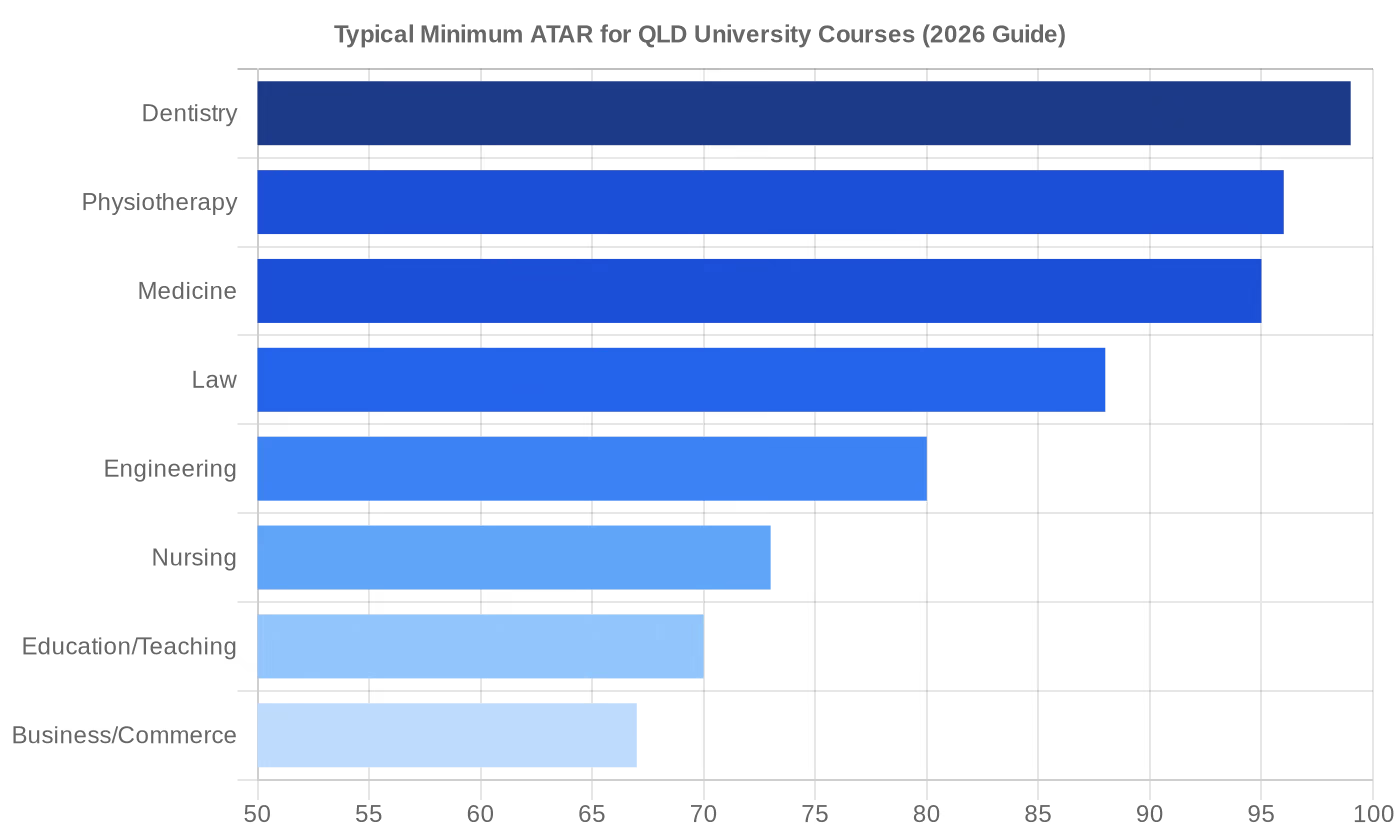
Source: Based on QTAC and university published cutoffs 2024–2025. Figures are typical minimums and shift year to year.
What ATAR Do You Need for Common Undergraduate Courses?
For the most commonly chosen undergraduate programs at Queensland universities, ATAR requirements are far more accessible. Most students pursuing nursing, teaching, engineering, or business are looking at selection ranks between 60 and 85, depending on the university and specialisation (QTAC, 2025).
Here's a realistic range for commonly chosen programs, based on recent cutoff trends:
Nursing
- UQ Bachelor of Nursing: minimum approximately 80.60 (UQ, 2025)
- QUT Bachelor of Nursing: typically 70–78
- Griffith Bachelor of Nursing: typically 65–73
- UniSQ Bachelor of Nursing: typically 60–68
Education and Teaching
- UQ Bachelor of Education (Primary): approximately 75 (UQ, 2025)
- QUT Bachelor of Education (Primary): typically 70–76
- USQ Bachelor of Education: typically 65–70
- JCU Bachelor of Education: typically 62–70
Engineering
- UQ Bachelor of Engineering (Honours): typically 82–88
- QUT Bachelor of Engineering (Honours): typically 75–84
- Griffith Bachelor of Engineering: typically 72–80
Business and Commerce
- UQ Bachelor of Business Management: typically 75–82
- QUT Bachelor of Business: typically 67–75
- Griffith Bachelor of Business: typically 62–70
Psychology
- UQ Bachelor of Psychological Science: typically 78–85
- QUT Bachelor of Psychological Science: typically 70–78
These are guidelines based on recent cutoff trends. Check the QTAC course search for current data before finalising your preferences, as cutoffs shift year to year with applicant demand.
How Does QCE Subject Scaling Work? — link to Apex subject scaling guide
How QTAC Adjustment Factors Can Boost Your Selection Rank
Most Queensland students qualify for at least one QTAC adjustment factor, and many don't realise it. An adjustment factor adds directly to your ATAR to form your selection rank, the figure universities actually assess, meaning your effective selection rank can be higher than your raw ATAR (QTAC, 2025).

University of Queensland (UQ)
Each adjustment equals 1 rank, up to a maximum of 5 total. Schemes include regional or remote location (2 ranks), subject performance bonus (1 rank per eligible subject), and First Nations identification (5 automatic adjustments) (UQ, 2025).
QUT
Up to 10.00 ATAR points can be added through adjustment schemes: regional or remote location (2–4 points), Educational Access Scheme for equity (2 points), and school performance bonus (up to 2 points) (QUT, 2025).
CQUniversity
All eligible non-metropolitan applicants who apply through QTAC receive an automatic 2-position adjustment, applied without a separate application (CQUniversity, 2025).
💡What this means practically: A student with a raw ATAR of 76 who qualifies for a regional adjustment (2 ranks at UQ) and a subject bonus (1 rank) has an effective selection rank of 79. That's the difference between being above or below the cutoff for several nursing and education programs. Running the adjustment calculation before submitting QTAC preferences takes five minutes and can change which programs are realistic targets.
What Are ATAR Requirements at Each Queensland University?
Different Queensland universities have different entry profiles based on their research intensity, program mix, and student intake. It's worth knowing the landscape before locking in your QTAC preferences.
University of Queensland (UQ) — Group of Eight research university, highest average cutoffs in Queensland. Competitive programs in medicine, law, science, and engineering. ATAR range across programs: approximately 70–99+.
Queensland University of Technology (QUT) — Strong in technology, business, design, and health. Known for industry connections. ATAR range: approximately 65–95 (QUT, 2025).
Griffith University — Large multi-campus institution on the Gold Coast and in Brisbane. Strong in health, law, criminology, and environment. ATAR range: approximately 58–95.
James Cook University (JCU) — Focus on tropical environments and health. Home to a medical school with lower ATAR thresholds than UQ. ATAR range: approximately 55–93.
Bond University — Private university on the Gold Coast with accelerated degrees and merit scholarships. Some programs accept ATARs from 60 upward.
CQUniversity / UniSQ — Regional universities with broad access programs and flexible entry. ATAR range: approximately 50–80, with strong enabling pathway options.
🎯What we see at Apex: Students often focus only on UQ or QUT and overlook JCU and Griffith, which offer the same degree with lower entry requirements and equivalent graduate registration outcomes. A JCU nursing graduate and a UQ nursing graduate both register with the same professional body — the degree title is identical.
What If You Don't Get the ATAR You Need?
Not meeting a cutoff doesn't mean you can't get into your chosen field. It means you need a different path in. Queensland has some of the most accessible alternative entry options in Australia, and most lead to the same degree within 12–18 months (QTAC, 2025). Why does this matter? Because students who rule out their preferred career after receiving a lower-than-expected ATAR often don't realise how many structured pathways exist.
Enabling and Tertiary Preparation Programs
Most Queensland universities offer free or subsidised enabling programs for students who don't meet direct ATAR entry. Completing one typically leads to a guaranteed conditional offer into a related degree. Examples include UQ's STEPS program and QUT College diploma pathways.
TAFE to University Pathway
A Certificate IV or Diploma from TAFE Queensland in a related field can earn credit into a university degree. A student who completes a Diploma of Nursing can apply for advanced standing into a Bachelor of Nursing, often reducing the degree to two years.
Internal Transfer
Starting in a related program at a lower cutoff, then transferring to your target program after first year, is a proven strategy. Universities typically require a minimum GPA of around 4.5–5.0 (on a 7-point scale) for internal transfers, not an ATAR.
Mature Age Entry
Students aged 21 or over can apply through QTAC using special entry assessment rather than ATAR. This may involve a portfolio, skills assessment, or statement of intent depending on the program.
If you're building toward a target ATAR, see our guides on how to create a study plan that works for you and scientifically proven strategies to improve how you study.
Frequently Asked Questions
What is the minimum ATAR to get into university in Queensland?
Most Queensland universities accept applications from students with ATARs from around 50–60 for select programs, particularly at regional universities and through enabling pathways (QTAC, 2025). There's no universal minimum, each course sets its own requirement, and mature-age and equity applicants can often enter without an ATAR at all.
Do all courses in Queensland require an ATAR?
No. Many programs accept TAFE qualifications, enabling program completion, work experience portfolios, or special entry schemes. Creative arts programs often use portfolios. Teaching and nursing programs frequently accept TAFE diplomas with advanced standing. Check each program on the QTAC course search for the full list of accepted entry qualifications.
Can adjustment factors change my ATAR after it's issued?
Your raw ATAR stays fixed after release, but your selection rank — what universities actually assess — can be higher if you qualify for QTAC adjustment factors. These add 1–10 points depending on institution and eligibility (QTAC, 2025). Check each university's adjustment schemes before assuming your raw ATAR is your effective entry score.
What ATAR do I need for medicine in Queensland?
UQ's provisional entry requires a selection rank of approximately 95 plus UCAT performance. JCU typically accepts selection ranks from around 91–93, also requiring UCAT. Griffith's Doctor of Medicine is graduate entry only — it requires a completed bachelor degree, not a school-leaver ATAR (QTAC, 2025). All three require separate applications beyond QTAC.
What if my score is just below the published cutoff?
Published cutoffs are based on the previous year's round and shift with demand. If your selection rank is close, you may still receive an offer in later rounds as places open. If you're below by several points, enabling programs, TAFE pathways, and internal transfers are reliable routes to your target degree within 12–18 months.
Conclusion
The ATAR you need for university in Queensland depends entirely on what you want to study and where. Most programs are accessible with scores between 60 and 85 — medicine, dentistry, and physiotherapy are the exceptions. Add in QTAC adjustment factors, and many students have a higher effective selection rank than their raw ATAR suggests.
If your ATAR lands below what you hoped, Queensland's enabling programs, TAFE pathways, and internal transfer options mean the path is rarely closed — just a step longer. Check your adjustment factor eligibility on QTAC, and map your backup pathways before results day so you're not making decisions under pressure.
If you're working toward a target ATAR and want subject-by-subject support, the Apex team works with QLD students across all senior subjects. Get in touch to talk through your target course and what you need to get there.
You might also like
- Why Past Papers Are The Best Way To Study For Exams
- How to Help Your Child Cope with Exam Stress and Achieve Academic Success
- Top Queensland Schools in 2025: Analysing the Best QCE ATAR Results
- Scientifically Proven Strategies to Improve How You Study
- How to Create a Study Plan that Works for You