

📝 Key Takeaways
- Every General subject in QCE includes three internal assessments (IAs) and one external exam (QCAA, 2026)
- Most General subjects weight IAs at 75% of the total mark; Maths and Sciences weight them at 50%
- IA types differ by subject — English uses spoken and written tasks, while Chemistry includes a research investigation and a hands-on experiment
- QCAA endorses every IA instrument before it is administered, then confirms teacher marking accuracy annually</aside>
What Are QCE Internal Assessments?
Queensland's General subjects each include three summative internal assessments that together count for either 50% or 75% of a student's final subject result (QCAA Senior Syllabuses, 2026). Each IA is a formally designed instrument, submitted to QCAA before it goes to students, and the marks feed directly into the ATAR calculation.
The split works like this: subjects in the Humanities, Arts, and Social Sciences are weighted 75% internal and 25% external. Maths and Science subjects flip the balance to 50% internal and 50% external, reflecting how much weight those disciplines place on externally verified written exams.

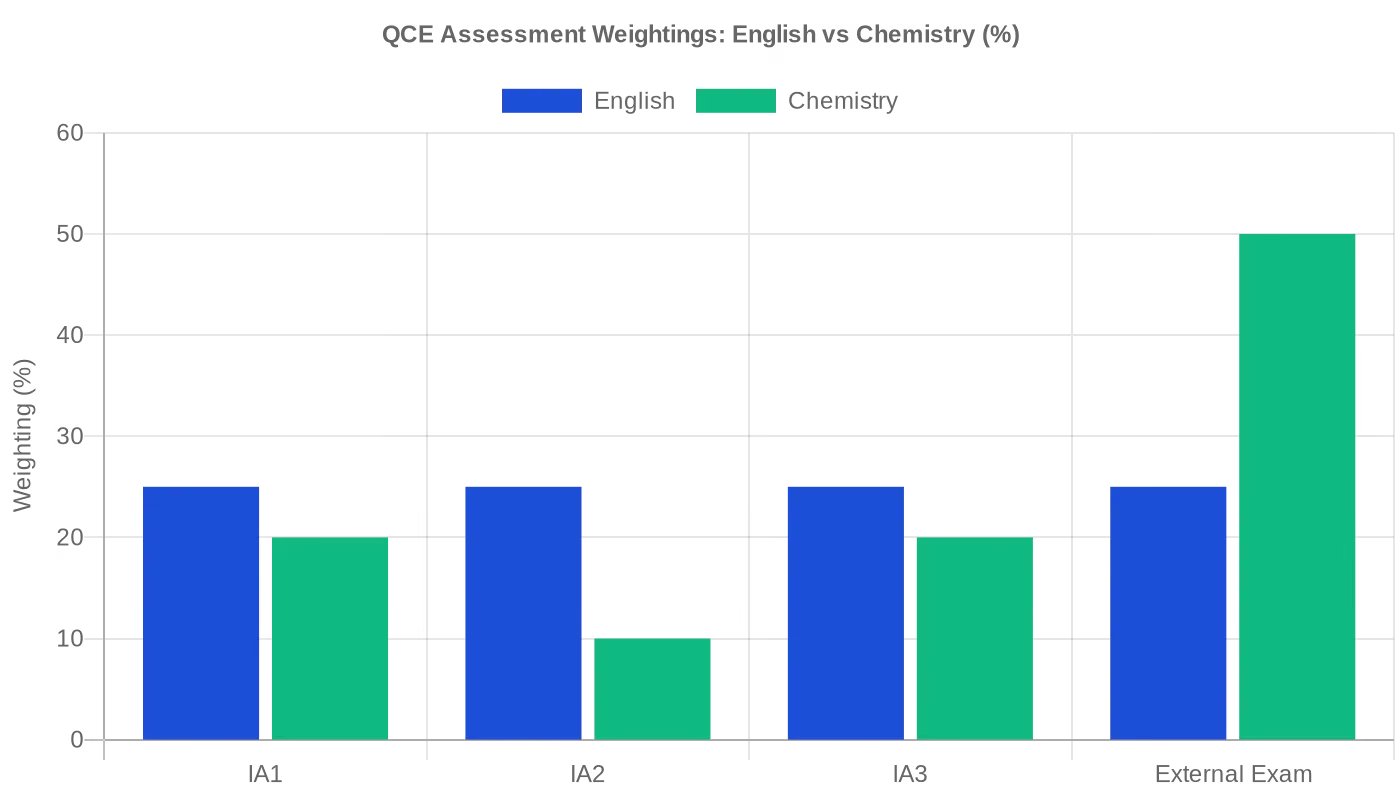
Source: QCAA Senior Syllabuses, 2026. English: 25% each component. Chemistry: IA1 20%, IA2 10%, IA3 20%, external 50%.
How Many IAs Does Each Subject Have?
Every General subject includes exactly three IAs, labelled IA1, IA2 and IA3, plus one external exam at the end of Year 12. The assessment types available across all General subjects are: examination, extended response, investigation, performance, product and project.
Not every subject uses all six types. Each syllabus specifies which combination applies. What stays consistent across every school in Queensland is the assessment condition, the same task type, the same time constraints, and the same marking criteria. A student sitting IA1 for Chemistry in Brisbane is assessed on the same criteria as a student sitting the same assessment in Cairns.
If your child is enrolled in Applied subjects rather than General subjects, the structure is different: Applied subjects don't contribute to the ATAR directly, so their assessment design is more flexible. This article focuses entirely on General subjects.
QCE Internal Assessments in English
English is one of the most commonly studied General subjects in Queensland, and its IA structure gives you a clear picture of how humanities-style assessments work (QCAA English Syllabus, 2026). All four components carry equal weight at 25% each.
IA1 — Extended Written Response (25%)
Students produce a piece of extended writing in response to literary texts. The task belongs to the "reading and creating" unit, and the audience is public. meaning the writing should be polished enough to share beyond the classroom. Think analytical essays, feature articles, or creative pieces that demonstrate deep engagement with the text.
IA2 — Persuasive Spoken or Multimodal Response (25%)
This is a formal spoken assessment. Students present a persuasive argument on an issue drawn from their texts or the broader world. It can be delivered as a speech or as a multimodal production combining spoken and visual elements.
IA3 — Examination: Written Response (25%)
IA3 is a school-based exam, sitting under supervised conditions. Students write imaginative or analytical responses to unseen or seen texts. Even though it's administered at school, the conditions and marking criteria are set by QCAA.

Worth knowing for parents: The spoken assessment in IA2 catches many students off guard because secondary schools in other states rarely include formal individual speeches as a graded component. If your child has recently moved from interstate, it's worth giving them extra practice opportunities before IA2 arrives.
Our guide on getting an A in QCE English covers how to approach each IA type in detail.
QCE Internal Assessments in Chemistry
Chemistry sits in the Science group where internal assessments make up only 50% of the final mark, with the other 50% coming from the external exam (QCAA Chemistry Syllabus, 2026). The IA types are also quite different, reflecting the investigative nature of the subject.
IA1 — Research Investigation (20%)
Students design, conduct, and report on a practical investigation. This is the largest single internal component in Chemistry, and it requires students to demonstrate scientific methodology: forming a hypothesis, controlling variables, collecting data, and analysing results. The written report is typically 1,500 to 2,000 words.
IA2 — Data Test (10%)
A short in-class test, usually 50 to 60 minutes, where students are given a set of data they haven't seen before and must interpret it under exam conditions. It carries the smallest weighting of any IA in Chemistry, but students who haven't practised data interpretation tend to underperform here relative to their overall ability.
IA3 — Student Experiment (20%)
Students conduct a hands-on practical under supervised conditions and write up their results. Unlike IA1, the experimental procedure is typically provided rather than designed by the student. The focus shifts from investigation design to execution accuracy and correct analysis.
The external exam in Chemistry carries twice the weight of any single IA. That's the reverse of most humanities subjects, where internal marks dominate. For students who perform better under controlled, practised conditions rather than high-pressure exams, this is a meaningful difference when choosing subjects in Year 10.
Our QCE Chemistry exam guide covers both the internal assessment tasks and what to expect from the external exam.
QCE Internal Assessments in Mathematical Methods
Mathematical Methods is one of the most demanding General subjects in Queensland and, as a Maths subject, its internal assessments carry only 50% of the final mark — with the other 50% from the external exam (QCAA Mathematical Methods Syllabus, 2026). The three IAs split that 50% unevenly: the open-ended task in Year 11 carries twice the weight of each school-based exam.
IA1 — Problem Solving and Modelling Task (20%)
Students investigate an open-ended mathematical problem and produce a written report demonstrating their reasoning and method. This is the largest single internal component. Unlike a timed exam, students work on it over several weeks — developing a model, testing it, and refining their approach. The final report must show not just correct answers but clear mathematical communication: justified steps, interpreted results, and evaluated limitations.
IA2 — Examination (15%)
A supervised school-based exam covering the first half of the syllabus. Students may use approved technology (a CAS calculator). QCAA sets the conditions and marking criteria; the school administers it. Expect a mix of short-response and extended-response questions across algebra, functions, and calculus.
IA3 — Examination (15%)
A second supervised exam covering later units of the syllabus. Same format as IA2. Together, IA2 and IA3 account for 30% of the total mark, with IA1 making up the remaining 20% of the internal component.
Worth knowing for parents: The PSMT catches many students off guard. They can solve every problem in a test but still underperform in IA1 because it requires something different — sustained mathematical writing, justification of every decision, and interpretation of results in plain language. This is a skill that needs deliberate practice before IA1 is due, not just mathematical ability.
Our Mathematical Methods exam guide covers how to approach each IA type and the external exam in detail.
QCE Internal Assessments in General Mathematics
General Mathematics follows the same IA structure as Mathematical Methods — a problem solving and modelling task plus two school-based exams, with the same 50/50 internal/external split (QCAA General Mathematics Syllabus, 2026). The format is identical; the content is fundamentally different.
IA1 — Problem Solving and Modelling Task (20%)
Same format as Mathematical Methods: an extended written investigation with a formal report. Topics are drawn from the General Maths syllabus — consumer arithmetic, statistics, measurement, or financial mathematics — so the scenarios tend to be practical and real-world. The report requirements, marking criteria, and QCAA endorsement process are the same as any other Maths subject.
IA2 — Examination (15%)
A supervised school-based exam covering the first half of the syllabus. Questions test skills in money, measurement, and data from Units 1 and 2. Students may use approved technology.
IA3 — Examination (15%)
A second supervised exam covering the remaining units. Together with IA2, these make up 30% of the final mark.
The key difference between General Mathematics and Mathematical Methods is not the IA format — it's the depth of content. General Maths focuses on applications in practical and financial contexts. Methods covers calculus, functions, and the mathematical foundations required for Science, Engineering, and Economics degrees. A student choosing between the two subjects will sit exactly the same IA types; what differs is the difficulty of the mathematics involved and, significantly, the scaling outcome.
Worth knowing for parents: In 2025, the median General Mathematics result (raw 69) scaled down to 59.54 — a loss of nearly 10 points. This doesn't mean General Maths is the wrong choice for a student whose strengths lie there. But students who are capable of managing Mathematical Methods should understand the scaling difference before deciding.
For a full breakdown of both subjects, see our General Mathematics subject page and our guide on QCE subject scaling.
What Does QCAA Endorsement Mean?
Before any IA can be handed to students, it must be endorsed by QCAA. Endorsement is the process by which QCAA-trained endorsers review the school's draft assessment instrument and confirm it is valid, accessible, and consistent with syllabus requirements (QCAA Assessment, 2026).
Schools submit their IA instruments through the QCAA Portal during scheduled submission windows. An endorser checks that:
- The task genuinely assesses the intended syllabus objectives
- The marking criteria align with QCAA's standards and not a looser school interpretation
- Students with different learning needs can access the task equitably
If an endorser identifies issues, the school must revise the instrument before administering it. This is why identical subject syllabuses produce comparable assessment quality across every Queensland school, whether it's a large Brisbane private school or a small regional campus.
According to QCAA's 2026 assessment guidelines, endorsement submission windows for each IA instrument occur in the term before the assessment is administered. Schools that miss a window cannot administer that IA until the next scheduled opportunity.
What Is Confirmation and How Does It Protect Your Child's Marks?
Where endorsement checks the instrument before students sit it, confirmation checks the marking after. QCAA's confirmation process is an annual review of whether teacher judgments across Queensland are accurate and consistent (QCAA Confirmation, 2026).
Think of confirmation as the QCE equivalent of moderation in other states, except it operates at scale across every General subject and every school simultaneously. A teacher in Toowoomba marking a Chemistry IA3 student experiment should reach the same standard judgment as a teacher in Townsville looking at equivalent work.
How it works:
- Schools submit samples of marked student work to QCAA
- QCAA-trained confirmers review the samples against the standards
- If a school's marks are found to be consistently higher or lower than the Queensland standard, adjustments are applied to the entire cohort
This means a generous marker at one school doesn't give students there an advantage, and a tough marker at another school doesn't unfairly penalise its students. The system is designed so your child's IA marks reflect what they actually produced, not which teacher happened to mark their folder.
For more on how Queensland subject results translate into an ATAR, see our analysis of top Queensland schools and QCE ATAR results.
How to Help Your Child Prepare for Internal Assessments
Because IAs are completed across Years 11 and 12, the preparation strategy is different from cramming for a single end-of-year exam. Each IA has a fixed administration window and, unlike external exams, it can't be re-sat.
A few things that make the biggest difference:
- Understand the criteria early. Each subject's assessment criteria are publicly available in the QCAA syllabus. Students who read and understand the criteria before starting an IA consistently outperform those who only look at them afterward.
- Practise the task type, not just the content. If IA2 is a spoken response, your child needs to practise speaking — not just researching the topic. The skills are different.
- Start the research investigation early. IA1 in Chemistry (and similar investigations in Biology, Physics, and other Sciences) typically has the longest lead time. Students who treat it like a last-minute assignment produce weaker reports.
- Use past papers to understand the task format. For IA types that resemble exam conditions — like IA2 data tests in Chemistry or IA3 written exams — working through past papers is one of the most efficient ways to build familiarity with the task structure.
If the IA workload is causing your child stress, our guide on helping your child cope with exam anxiety has practical strategies that work for sustained assessment periods, not just exam week.
Our study plan guide can help your child map out when to start preparing for each IA window across Years 11 and 12.
Getting support at the right time matters. At Apex Tuition Australia, our QCE tutors work with students across English, Chemistry, Physics, Biology, Maths Methods and more — preparing them for each IA in the weeks before it's due, not just at exam time. Apply to work with a QCE tutor today.
Frequently Asked Questions
Can my child redo an internal assessment if they do poorly?
No. Each IA is administered once during a fixed window, and the mark stands. This is different from some other states where school-based assessments can be revised. The confirmation process protects consistency, but there's no re-sit mechanism for IAs.
Do all General subjects have the same IA structure?
No. While every General subject has exactly three IAs, the task types, weightings, and conditions vary by syllabus. Humanities subjects typically split 75/25 internal/external, while Maths and Sciences split 50/50. The specific task types, investigation, examination, extended response, and so on, are set by each subject's QCAA syllabus.
What happens if a student misses an IA due to illness?
Schools have documented procedures for managing absences during IA windows, and students may be eligible for a make-up opportunity in some circumstances. This is governed by the school's assessment policy and QCAA guidelines. A medical certificate is typically required.
How does IA marking affect a student's ATAR?
IA marks are reported to QCAA as part of the final subject result. That result, combined with the external exam mark, produces an overall percentage that feeds into the ATAR scaling process through the Queensland Tertiary Admissions Centre (QTAC).
Is the QCE internal assessment system the same as the old OP system?
No. Under the OP (Overall Position) system, school assessments were also included, but the scaling and comparability mechanisms were different. The current QCE system, introduced in 2019, was designed to produce results comparable to interstate ATARs, with QCAA endorsement and confirmation providing standardisation across all Queensland schools.
What to Expect Across Years 11 and 12
QCE internal assessments aren't something that happens at the end of Year 12. IA1 is typically completed in Year 11, IA2 in early-to-mid Year 12, and IA3 in the second half of Year 12. That means the year before external exams is already heavy with assessed tasks.
The best preparation combines understanding how each specific subject's IA tasks work, knowing the QCAA criteria that guide marking, and practising the exact skills the task type requires. Whether your child is writing an extended response for English or designing a Chemistry experiment, the criteria are the same document their teacher uses to mark them.
Understanding the QCE cognitive verbs used in every IA criteria sheet is one of the highest-leverage things a student can do before IA season begins.