.avif)

In 2025, 57,909 Queensland students completed Year 12 — and 93.4% of them walked away with a Queensland Certificate of Education (QCAA, 2025). But a surprising number of students start senior school without fully understanding how that certificate is actually earned. What counts as a credit? Do you need an ATAR? What if you don't finish in time?
This guide breaks down exactly how the QCE works, so you and your family can plan senior schooling with confidence.
💡Key Takeaways
- You need 20 credits to earn a QCE, with at least 12 from completed Core courses (QCAA, 2026).
- General subjects count toward both your QCE and ATAR; Applied subjects count toward QCE only (with one exception).
- 93.4% of Queensland Year 12 graduates earned their QCE in 2025 (QCAA, 2025).
- The QCE and the ATAR are separate — you can earn one without the other.
- From 2026, all Year 12 graduates must complete an academic integrity course as a new QCE requirement.</aside>
What is the QCE?
The Queensland Certificate of Education is Queensland's senior secondary schooling qualification, awarded by the Queensland Curriculum and Assessment Authority (QCAA). It's the document that officially recognises what you achieved in Years 11 and 12, and it's recognised across Australia and internationally as evidence of senior school completion.
The QCAA is the state government authority responsible for curriculum, assessment standards, and certification in Queensland schools. From the moment you start Year 11, every credit you earn and every assessment result your teacher records is tracked on your QCAA learning account, a digital record that follows your progress all the way through to graduation.
One important clarification upfront: earning a QCE doesn't automatically mean you receive an ATAR. The two are connected but separate. We'll explain the difference in a later section.

How Do You Earn QCE Credits?
The QCE runs on a credit system. To graduate with your certificate, you need to accumulate 20 credits from approved learning options — but there's a specific pattern you must follow, not just a points total (QCAA, 2026).
The required credit pattern:
A credit is only awarded when you meet the set standard, a C grade or above, demonstrated competency, or qualification completion, depending on the subject type. Partial completion of a Core course can still contribute to your 20-credit total, but won't count toward the 12 credits that must come from fully completed courses.
Most students aim for 24 credits (six subjects, four credits each), which builds in a buffer. The maximum available is 28 credits.
💡Worth knowing: The credit structure is deliberately forgiving. If one subject goes badly, you don't lose everything. Your worst result still contributes to your 20-credit total — it just won't help your ATAR. This is one reason most students study six subjects rather than five.
What Types of Subjects Count Towards Your QCE?
Not all learning looks the same in the QCE system. Queensland offers several pathways, and each contributes differently to your certificate and ATAR eligibility.
General Subjects
General subjects are academically rigorous courses combining school-based and external assessment. They contribute credits toward your QCE and are the primary source of ATAR scores. Most students aiming for university choose four to five General subjects.
Each General subject spans four units across Years 11 and 12. Units 1 and 2 (Year 11) are formative, your teachers assess you, but results don't count toward your ATAR. Units 3 and 4 (Year 12) are summative and do count.
Applied Subjects
Applied subjects are more practical and hands-on, assessed entirely through school-based work, no external exam. They contribute to your QCE, and one Applied subject can also contribute to your ATAR when combined with four General subjects.
If university isn't your goal, a program of Applied subjects still earns you a full QCE and prepares you well for vocational pathways, employment, or TAFE.
VET Qualifications and School-Based Apprenticeships
Vocational Education and Training (VET) qualifications, from Certificate I through to Diploma level, count toward your QCE as Core or Complementary learning. In 2025, over 40,760 Queensland Year 12 students completed a VET qualification while still at school (QCAA, 2025). School-based apprenticeships and traineeships (SBATs) also count.
Short Courses and University Subjects
QCAA Short Courses (such as the Literacy Short Course or Numeracy Short Course) contribute one credit each and can help students who need to top up their credit total or meet literacy and numeracy requirements. In 2025, 1,683 students also completed a university subject at school (QCAA, 2025).
How Does Assessment Work in Year 11 and Year 12?
Assessment is one of the biggest adjustments students make in senior school. The structure differs depending on your subject type.
General Subjects: Internal and External
General subjects use a split between school-based and QCAA-set assessment.
- Internal assessments make up 75% of your final subject result
- External assessments (sat during a four-week exam period at the end of Year 12) make up 25%
- For Mathematics and most Science subjects, it's an even 50% internal / 50% external split
Internal assessments vary by subject, they can include extended response tasks, research investigations, experimental reports, or supervised in-class pieces. External assessments are set and marked by the QCAA, not your school.
Applied Subjects: Internal Only
Applied subjects have four internal assessments and no external exam. Your final subject result comes entirely from school-based work throughout the year.


What Are the Literacy and Numeracy Requirements?
Accumulating 20 credits isn't enough on its own, you also need to demonstrate that you've met Queensland's literacy and numeracy benchmarks.
The QCAA sets these standards, and students can satisfy them through several pathways: achieving the minimum standard in an approved QCAA subject (such as English or Essential Mathematics), completing a QCAA Short Course, or meeting the benchmark through an approved assessment offered by the authority.
Your school's senior schooling coordinator can check your QCAA learning account at any time to confirm your status. Don't leave this until Year 12 — if you're behind, you want time to address it.
Does the QCE Give You an ATAR?
This is the most common misunderstanding in Queensland senior schooling. The QCE and the ATAR are separate.
The QCE is a certificate confirming you completed senior school to the required standard. The ATAR (Australian Tertiary Admission Rank) is a percentile rank used for university entry, calculated from your Year 12 subject results.
❗You can earn a QCE without receiving an ATAR, and many students do.
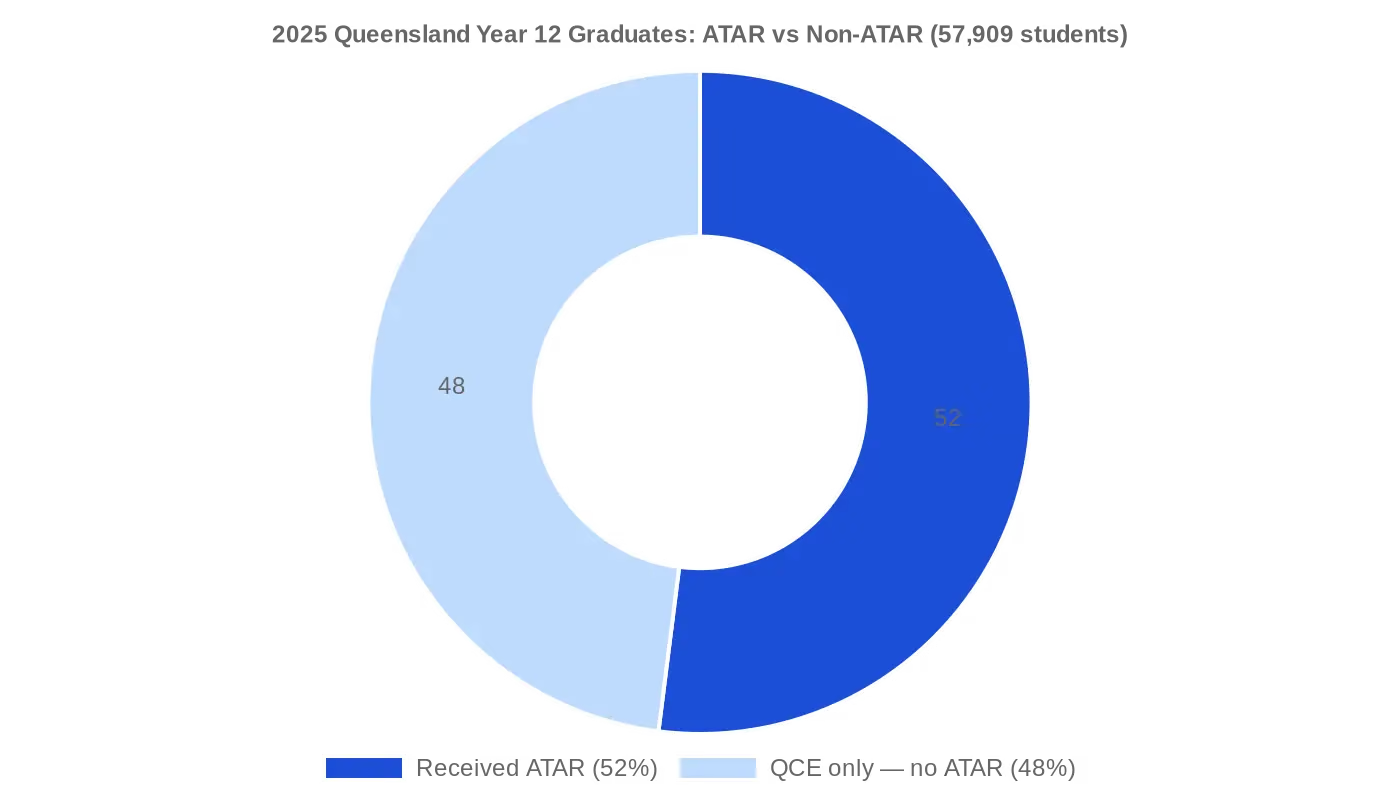
In 2025, approximately 30,167 Queensland students received an ATAR, roughly 52% of the Year 12 cohort (QCAA, 2025). The other 48% earned their QCE through VET, Applied subject pathways, or other non-ATAR options.
How the ATAR Is Calculated
Your ATAR is calculated from your five best General subject results in Year 12. If you studied six subjects, the lowest-performing one becomes your "grace subject" and is excluded. Raw scores are then scaled based on how all Queensland students perform in each subject statewide.
Key 2025 benchmarks:
- 99.95 = top 0.05% of Queensland (37 students achieved this in 2025)
- 90+ = top 10% (nearly 25% of ATAR recipients reached this)
- 70 = approximately top 30% of state
⚠️A common trap: Some students choose subjects specifically because they think they'll scale well. Scaling patterns shift every year, and a subject you dislike is unlikely to deliver the results needed for scaling to matter. Choose subjects where you can genuinely perform — that's still the strongest ATAR strategy.
What's New in 2026: The Academic Integrity Requirement
From 2026, Year 12 graduates must complete an academic integrity course during their senior schooling as a condition of receiving the QCE (QCAA, 2026). This is a new addition to the system, designed to ensure students understand ethical scholarship before entering university or the workforce.
The requirement doesn't apply to anyone who finished — or was scheduled to finish — Year 12 before August 2026. Your school manages enrolment in the course. If you're currently in Year 11 or 12, check with your senior schooling coordinator to confirm you're on track.
Frequently Asked Questions
Can you get a QCE without doing an ATAR?
Yes. Plenty of Queensland students earn a full QCE without ever receiving an ATAR. Applied subjects, VET qualifications, SBATs, and other approved learning options all contribute credits toward the QCE without contributing to an ATAR score. This pathway suits students heading into trades, vocational work, or who plan to apply to university through a different route.
What if you don't finish your QCE in Year 12?
Your QCAA learning account stays open after you leave school. Credits already earned remain on your record, and you can continue working toward the 20-credit requirement through approved providers. You don't need to start from scratch.
Do Year 11 results count toward your ATAR?
No. Year 11 results (Units 1 and 2) are formative and don't contribute to your ATAR. They're important for building skills, confirming subject choices, and securing credits — but your ATAR is calculated solely from Year 12 (Units 3 and 4) results.
How many subjects do most students take?
Most Queensland students study five or six subjects across Years 11 and 12. Six subjects (each worth four credits) gives 24 credits — four more than the minimum — which provides a safety net if one subject underperforms.
Is a Queensland QCE recognised in other states?
Yes. The QCE is recognised across Australia and internationally as evidence of completed senior secondary education. ATARs calculated in Queensland are accepted by universities in every other Australian state.
Conclusion
The QCE is earned credit by credit across Years 11 and 12 — built through the subjects you choose, the assessments you complete, and the standards you meet. Get to 20 credits in the right pattern, satisfy the literacy and numeracy requirements, and (from 2026) complete the academic integrity course, and the certificate is yours.
Understanding the system early is the biggest advantage you can give yourself. Subject choices made in Year 10 have a direct impact on your credit total, your ATAR eligibility, and your options after school. The earlier you understand how it all fits together, the more deliberately you can build your senior schooling program.
Related Posts
Sources: Queensland Curriculum and Assessment Authority (QCAA), 2025 Results Snapshot; Queensland Government, Ministerial Media Statement 2025; QCAA, QCE Eligibility Requirements 2026, QCE ATAR Guide 2025.