

In 2025, Queensland had 57,909 Year 12 students. About half of them received an Australian Tertiary Admission Rank (QCAA, 2025). The other half earned their Queensland Certificate of Education through VET, Applied subjects, and other pathways, and many made that choice without fully understanding what the ATAR system actually involves.
The QCE ATAR calculation has more moving parts than most students expect. It covers raw scores, an iterative scaling process, and a final ranking exercise run. None of these steps is especially complicated on its own, but most guides skip the detail that actually matters.
We will cover everything you need to know here!
📋Key Takeaways
- 52% of Queensland's 57,909 Year 12 students received an ATAR in 2025 (QCAA, 2025).
- The ATAR is a percentile rank, not a percentage — ATAR 80 means you outperformed 80% of your cohort.
- Your ATAR uses your five best scaled scores, combined via QTAC's iterative polyrank system.
- Raw scores are scaled — a 90 in Specialist Maths is worth more than a 90 in Dance.
- 37 students achieved the top rank of 99.95 in 2025 (Qld Government, 2025).</aside>
What Does the QCE ATAR Actually Measure?
The ATAR is a percentile rank, not a score out of 100. In 2025, the top 0.05% of the Queensland Year 12 cohort, about 37 students, received the maximum ATAR of 99.95 (Queensland Government, 2025). An ATAR of 80.00 means you outperformed 80% of your Year 12 age cohort. An ATAR of 50.00 means you sit exactly in the middle.
The scale runs from 0.00 to 99.95, in 0.05 increments, creating 2,000 distinct ATAR bands. Two separate organisations are involved. The Queensland Curriculum and Assessment Authority (QCAA) certifies your subject results. The Queensland Tertiary Admissions Centre (QTAC) uses those results to calculate your ATAR. They're separate bodies with separate roles, and most students conflate them.
💡Worth knowing: Your ATAR is a rank, not a grade. You could perform better than last year's cohort across the board and still receive an identical ATAR if everyone else improved at the same rate. The number reflects your position in the field, not your absolute performance.
Who Qualifies for a QCE ATAR?
Only about half of Queensland Year 12 students receive an ATAR. To qualify, you need to meet specific subject and English requirements set by QTAC (QTAC, 2025).

Subject requirements, you must complete Units 3 and 4 in:
- Five General subjects, OR
- Four General subjects plus one Applied subject, OR
- Four General subjects plus a VET qualification at Certificate III or above
English requirement: You must achieve a result of C or above in at least one of these five QCAA English subjects: English, English as an Additional Language, Literature, or Essential English.
Precluded combinations: You can't include both a General and Applied version of the same subject area. If you study General Mathematics and Essential Mathematics, only one can count toward your ATAR.
Five-year currency: Scaled subject results remain valid for five years, letting students who defer or return to study carry forward previous results.

In 2025, approximately 30,100 of Queensland's 57,909 Year 12 students received an ATAR. If university is your goal, ATAR eligibility has to be part of your subject selection plan from the start of Year 11, not a decision you revisit in Year 12.
Step 1: How Your Raw Subject Scores Are Built
Your ATAR draws only on Units 3 and 4. Year 11 (Units 1 and 2) does not contribute to your ATAR, though it counts toward your QCE credits. Each subject generates one raw score out of 100, combining your school-based assessment results with your QCAA external examination.
The internal/external split depends on the subject type:
Your school-based result for most subjects comes from three internal assessments (IA1, IA2, IA3) completed across Year 12, marked against QCAA criteria.
👥What we see from our Brisbane students: Students often underestimate the internal assessment weight. With a 75% internal split in humanities subjects, three strong IA results do more ATAR work than a strong exam result alone. Getting IA1 right (not just surviving it) is where ATAR scores are often made or lost.
Step 2: Scaling
Once QCAA sends raw scores to QTAC, every result goes through scaling. The Queensland scaling system adjusts raw scores based on the performance of the cohort that studied each subject, not based on a fixed subject difficulty rating (QTAC, 2025).
The logic: if the students who study Specialist Mathematics also score highly across their other subjects, that signals an academically strong cohort. A Specialist Maths result is therefore worth more. If Dance students tend to score lower across other subjects, Dance results are adjusted down.
Using 2024 QTAC data
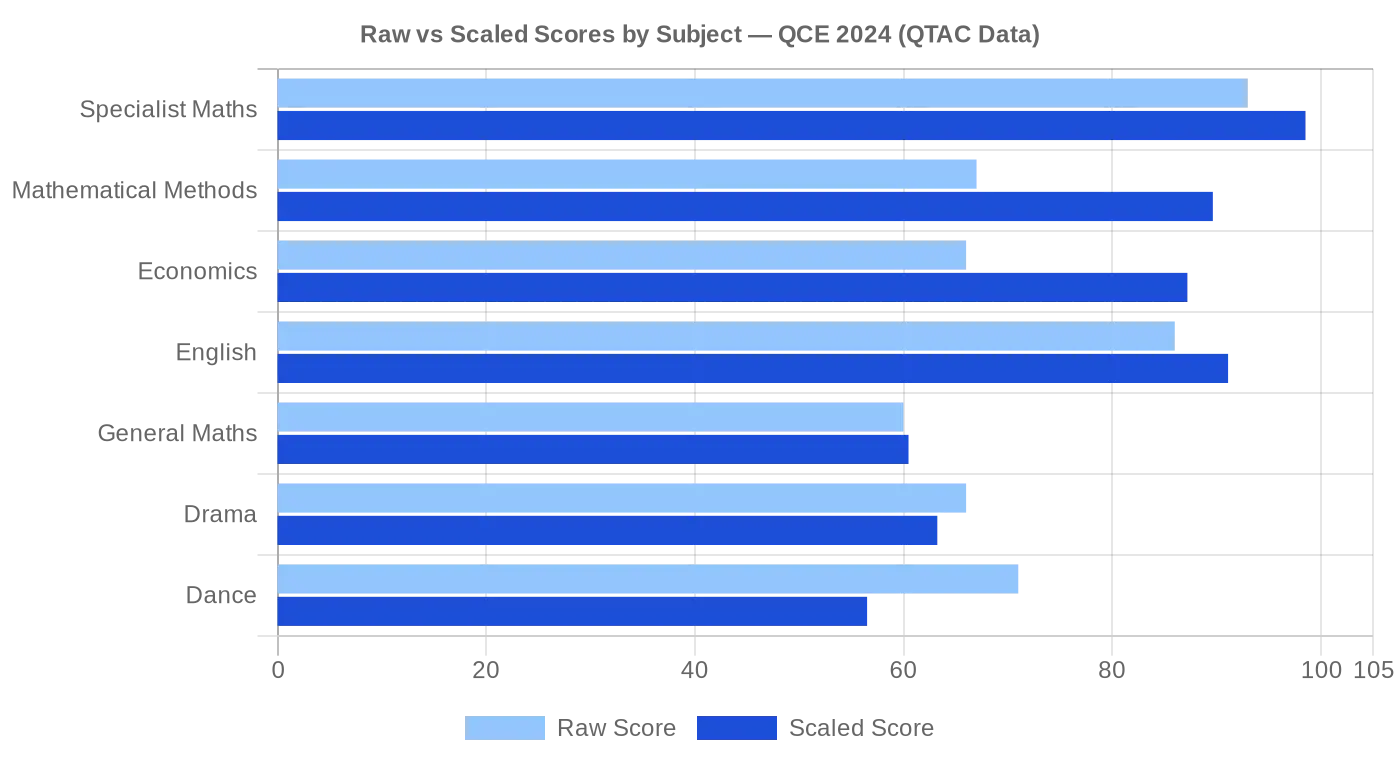
A raw score of 67 in Mathematical Methods scaled to 89.65. A raw score of 71 in Dance scaled to just 56.51. That's a 33-point difference in scaled score from a 4-point difference in raw score. Subject choice shapes your ATAR long before you sit the exam.
Scaling percentages shift every year based on that year's cohort. No one can tell you in Year 10 exactly how your subjects will scale by the time you sit.
Step 3: The Polyrank System — The Engine Behind QCE Scaling
QTAC's scaling uses an iterative process called the polyrank system. Most competing guides skip this part. It's worth understanding, because it explains why Queensland scaling is more sophisticated than a fixed multiplier.
A student's polyrank is the average of their top five scaled subject scores. The system works like this:
- QTAC selects a student's raw score in one subject, then finds every other ATAR-eligible Queensland student who scored that exact same raw score in that subject.
- QTAC averages the polyranks of all those students. That average becomes the new scaled score for that raw score in that subject.
- This updates polyranks, which changes scaled scores, which changes polyranks again. The cycle repeats until the numbers stabilise (typically a few dozen iterations).
The result: subjects studied by a strong cohort naturally produce higher scaled scores. There's no manual assignment of scaling factors. The algorithm is self-correcting, which is why it remains fair even when subject enrolment patterns shift year to year.
QTAC publishes the full technical specification in its ATAR Calculation Technical Document for anyone who wants the mathematical detail.
Step 4: Your Tertiary Entrance Aggregate (TEA)
Once all scaling iterations stabilise, QTAC identifies your five best scaled scores. It adds them together to create your Tertiary Entrance Aggregate (TEA). If you studied more than five ATAR-eligible subjects, the lowest-scoring one is dropped entirely. This dropped subject is sometimes called your "grace subject." It doesn't help your TEA, but it doesn't hurt it either.
TEA scores typically fall in the range of approximately 250 to 500 (QTAC, 2025), depending on overall scaled performance. The number itself carries no meaning in isolation. It's only meaningful relative to every other eligible student's TEA, which is exactly what Step 5 uses it for.
.avif)
Step 5: How QTAC Converts Your TEA to an ATAR Score
QTAC takes every eligible Queensland student's TEA and ranks them from highest to lowest. It then distributes those students across 2,000 ATAR bands, from 99.95 down to 0.00 in steps of 0.05. Each band contains roughly the same proportion of the total Queensland Year 12 age cohort, including students who didn't sit for an ATAR at all. That's why the ATAR is a rank within your full age group, not just among ATAR recipients.
In practice, the top group by TEA receives 99.95. The next group receives 99.90. This continues down to 0.00.

In 2025, 37 students achieved ATAR 99.95, and more than 24% of eligible ATAR recipients scored 90 or above (Queensland Government, 2025). An ATAR of 90 places you in the top 10% of your cohort, a threshold many competitive Queensland university programs use as a minimum entry score.
Which QCE Subjects Scale Up in Queensland?
Scaling changes annually. There's no guarantee that patterns in past year will hope up. That said, the following patterns have been consistent across multiple years of QTAC data.
Subjects that consistently scale up:
- Specialist Mathematics (historically the strongest)
- Mathematical Methods
- Physics and Chemistry
- Economics
- Literature (tends to scale above General English)
- French
Subjects that have historically scaled down:
- Dance, Drama
- General Mathematics
- Physical Education
⚠️Don't chase scaling blindly. A student who scores 80 in a moderate-scaling subject will usually outperform a student who scores 55 in a high-scaling one. Choose subjects where you'll genuinely perform, then let the cohort effect work for you. Don't make subject decisions based on scaling predictions that won't be confirmed until results day.
If you're planning your QCE subject selection and want to understand your realistic ATAR range, our tutors across Queensland work with Year 11 and 12 students to build subject programs that align with their goals. Whether you're targeting 90+ or just getting clear on what's achievable, we can help you build a plan.
❗Also worth reading: General vs Applied Subjects: Which Is Right for Your QCE? — understanding which subject types count toward your ATAR is the foundation of any ATAR strategy.
Frequently Asked Questions
Is the QCE ATAR calculated the same way as in other states?
No. Each state calculates its own ATAR. In Queensland, QTAC runs the polyrank iterative system described above. In New South Wales, UAC uses a different moderation process. In Victoria, VTAC uses a different scaling model entirely. If you're moving between states mid-senior schooling, check with the destination state's admissions centre — eligibility rules and calculation methods differ.
Does my Year 11 result affect my ATAR?
Year 11 (Units 1 and 2) results do not feed into your ATAR calculation. Only Units 3 and 4 (Year 12) results are sent to QTAC. Your Year 11 results do count toward your QCE credit total, and a low Year 11 credit count creates pressure in Year 12 — but they won't directly move your ATAR number.
Can I use a VET qualification in my ATAR calculation?
Yes, under the right conditions. A completed VET qualification at Certificate III level or above can replace one Applied subject when paired with four General subjects. The VET result receives a standardised scaled score based on its AQF level. Not all VET qualifications qualify — QTAC publishes the current approved list.
What ATAR do I need for university in Queensland?
Entry requirements vary by institution and course. Most Queensland undergraduate programs require ATARs between 50 and 99.95. Competitive programs like medicine, dentistry, and law at UQ typically require 97 or above. QTAC publishes current minimum entry requirements at qtac.edu.au. Your ATAR is one pathway — bonus points for regional status, first-in-family, and subject bonuses may also adjust your selection rank.
Can a tutor help improve my ATAR?
Yes of course. QCE tutors can provide very targeted guidance and instruction on content as well as exam technique. A private tutor can be a great way to help get the extra edge and improve your score.
Conclusion
The QCE ATAR calculation runs in five steps: building raw scores from internal assessment and external exams, scaling those scores through QTAC's iterative polyrank system, summing your five best scaled scores into a Tertiary Entrance Aggregate, and converting that aggregate into a percentile rank across the Queensland cohort.
The part that catches most students out is scaling. A high raw score in a subject with a weak cohort produces a lower scaled score than a moderate raw score in a subject with a strong cohort. Subject selection is ATAR strategy. Choose well in Year 10, and the system works for you.
Sources: QCAA, 2025 Results Snapshot; Queensland Government, 2025 ATAR Results Statement; QTAC, ATAR Information; KIS Academics, How Is the ATAR Calculated in Queensland? and 2024 Subject Scaling Guide.