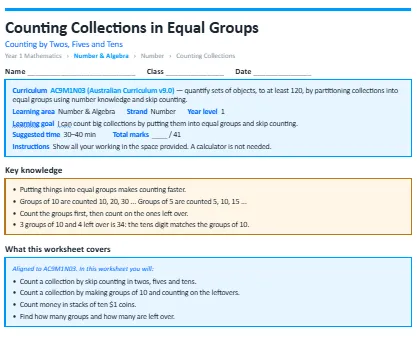
This worksheet teaches students to count large collections by putting them into equal groups and skip counting by twos, fives and tens, then counting on the leftovers. The worksheet is split into warm-up questions, standard questions and then extension questions to test you.
The concepts it covers:
- Putting things into equal groups makes counting faster.
- Groups of 10 are counted 10, 20, 30 ... Groups of 5 are counted 5, 10, 15 ...
- Count the groups first, then count on the ones left over.
- 3 groups of 10 and 4 left over is 34: the tens digit matches the groups of 10.
What your child will practise:
- Counting a collection by skip counting in twos, fives and tens.
- Counting a collection by making groups of 10 and counting on the leftovers.
- Counting money in stacks of ten $1 coins.
- Finding how many groups and how many are left over.
Every section opens with a worked example, and the download includes a full answer key with step-by-step solutions and teaching notes on the mistakes students most commonly make.