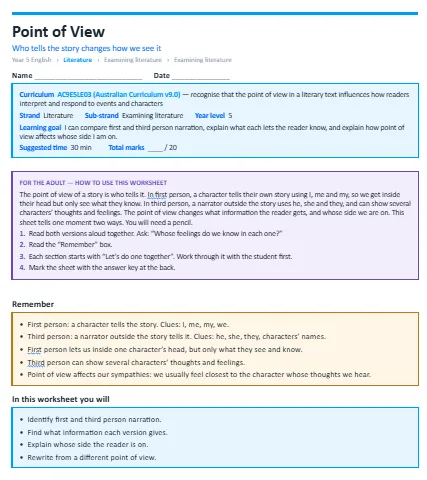
This worksheet teaches students to compare first and third person versions of the same moment, explain what each lets the reader know, and how point of view shapes whose side we are on. The worksheet is split into easy, medium and hard sections, plus an extension task to stretch confident students.
The concepts it covers:
- First person: a character tells the story. Clues: I, me, my, we.
- Third person: a narrator outside the story tells it. Clues: he, she, they, characters’ names.
- First person lets us inside one character’s head, but only what they see and know.
- Third person can show several characters’ thoughts and feelings.
- Point of view affects our sympathies: we usually feel closest to the character whose thoughts we hear.
What your child will practise:
- Identifying first and third person narration.
- Finding what information each version gives.
- Explaining whose side the reader is on.
- Rewriting from a different point of view.
Every section opens with a “Let’s do one together” example and a short note for the adult helping. The download includes a full answer key, with marking guides for open answers and teaching notes.