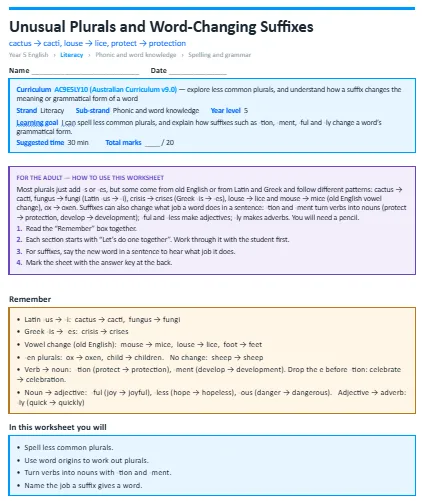
This worksheet teaches students to spell less common plurals such as cacti, lice and crises, and to explain how suffixes such as -tion, -ment, -ful and -ly change a word’s grammatical form. The worksheet is split into easy, medium and hard sections, plus an extension task to stretch confident students.
The concepts it covers:
- Latin -us → -i: cactus → cacti, fungus → fungi
- Greek -is → -es: crisis → crises
- Vowel change (old English): mouse → mice, louse → lice, foot → feet
- -en plurals: ox → oxen, child → children. No change: sheep → sheep
- Verb → noun: -tion (protect → protection), -ment (develop → development). Drop the e before -tion: celebrate → celebration.
- Noun → adjective: -ful (joy → joyful), -less (hope → hopeless), -ous (danger → dangerous). Adjective → adverb: -ly (quick → quickly)
What your child will practise:
- Spelling less common plurals.
- Using word origins to work out plurals.
- Turning verbs into nouns with -tion and -ment.
- Naming the job a suffix gives a word.
Every section opens with a “Let’s do one together” example and a short note for the adult helping. The download includes a full answer key, with marking guides for open answers and teaching notes.