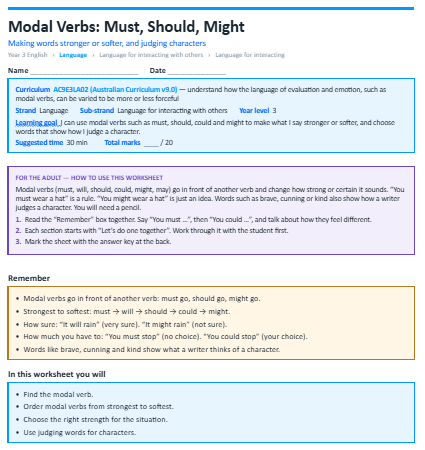
This worksheet teaches students how modal verbs such as must, should, could and might make language stronger or softer, and how words like brave, cunning and greedy show how a writer judges a character. The worksheet is split into easy, medium and hard sections, plus an extension task to stretch confident students.
The concepts it covers:
- Modal verbs go in front of another verb: must go, should go, might go.
- Strongest to softest: must → will → should → could → might.
- How sure: “It will rain” (very sure). “It might rain” (not sure).
- How much you have to: “You must stop” (no choice). “You could stop” (your choice).
- Words like brave, cunning and kind show what a writer thinks of a character.
What your child will practise:
- Finding the modal verb.
- Ordering modal verbs from strongest to softest.
- Choosing the right strength for the situation.
- Using judging words for characters.
Every section opens with a “Let’s do one together” example and a short note for the adult helping. The download includes a full answer key, with marking guides for open answers and teaching notes.