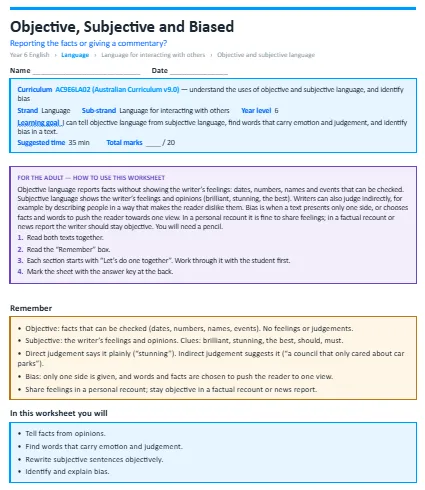
This worksheet teaches students to tell objective from subjective language, find words that judge directly and indirectly, and identify bias by comparing a news report with an editorial. The worksheet is split into easy, medium and hard sections, plus an extension task to stretch confident students.
The concepts it covers:
- Objective: facts that can be checked (dates, numbers, names, events). No feelings or judgements.
- Subjective: the writer’s feelings and opinions. Clues: brilliant, stunning, the best, should, must.
- Direct judgement says it plainly (“stunning”). Indirect judgement suggests it (“a council that only cared about car parks”).
- Bias: only one side is given, and words and facts are chosen to push the reader to one view.
- Share feelings in a personal recount; stay objective in a factual recount or news report.
What your child will practise:
- Telling facts from opinions.
- Finding words that carry emotion and judgement.
- Rewriting subjective sentences objectively.
- Identifying and explaining bias.
Every section opens with a “Let’s do one together” example and a short note for the adult helping. The download includes a full answer key, with marking guides for open answers and teaching notes.