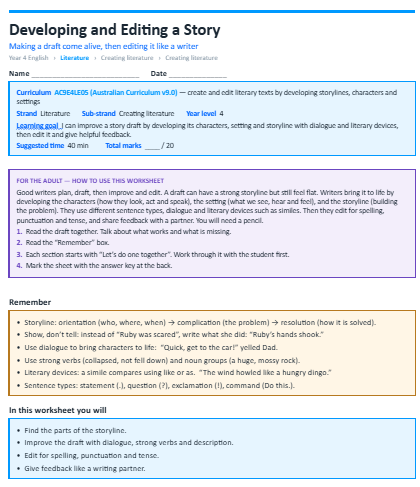
This worksheet teaches students to bring a plain story draft to life with dialogue, strong verbs, noun groups and similes, then edit a paragraph for spelling, tense and punctuation and give feedback like a writing partner. The worksheet is split into easy, medium and hard sections, plus an extension task to stretch confident students.
The concepts it covers:
- Storyline: orientation (who, where, when) → complication (the problem) → resolution (how it is solved).
- Show, don’t tell: instead of “Ruby was scared”, write what she did: “Ruby’s hands shook.”
- Use dialogue to bring characters to life: “Quick, get to the car!” yelled Dad.
- Use strong verbs (collapsed, not fell down) and noun groups (a huge, mossy rock).
- Literary devices: a simile compares using like or as. “The wind howled like a hungry dingo.”
- Sentence types: statement (.), question (?), exclamation (!), command (Do this.).
What your child will practise:
- Finding the parts of the storyline.
- Improving the draft with dialogue, strong verbs and description.
- Editing for spelling, punctuation and tense.
- Giving feedback like a writing partner.
Every section opens with a “Let’s do one together” example and a short note for the adult helping. The download includes a full answer key, with marking guides for open answers and teaching notes.