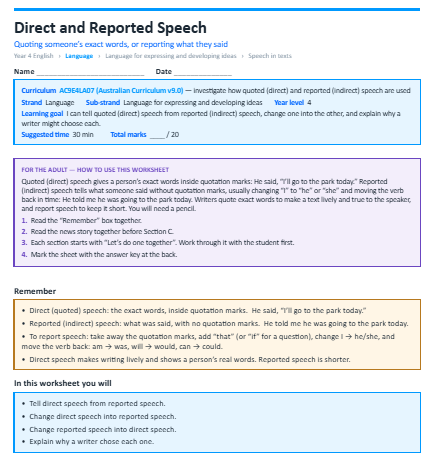
This worksheet teaches students to tell quoted (direct) speech from reported (indirect) speech, change one into the other, and explain why a news story about a lost dog uses each. The worksheet is split into easy, medium and hard sections, plus an extension task to stretch confident students.
The concepts it covers:
- Direct (quoted) speech: the exact words, inside quotation marks. He said, “I’ll go to the park today.”
- Reported (indirect) speech: what was said, with no quotation marks. He told me he was going to the park today.
- To report speech: take away the quotation marks, add “that” (or “if” for a question), change I → he/she, and move the verb back: am → was, will → would, can → could.
- Direct speech makes writing lively and shows a person’s real words. Reported speech is shorter.
What your child will practise:
- Telling direct speech from reported speech.
- Changing direct speech into reported speech.
- Changing reported speech into direct speech.
- Explaining why a writer chose each one.
Every section opens with a “Let’s do one together” example and a short note for the adult helping. The download includes a full answer key, with marking guides for open answers and teaching notes.