This worksheet teaches students to choose formal or informal language to suit the person and the situation, such as moving from group chat to presenting a report, and to use inclusive language that leaves no one out. The worksheet is split into easy, medium and hard sections, plus an extension task to stretch confident students.
The concepts it covers:
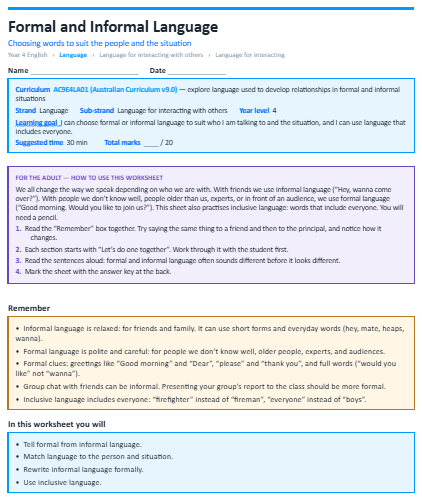
- Informal language is relaxed: for friends and family. It can use short forms and everyday words (hey, mate, heaps, wanna).
- Formal language is polite and careful: for people we don’t know well, older people, experts, and audiences.
- Formal clues: greetings like “Good morning” and “Dear”, “please” and “thank you”, and full words (“would you like” not “wanna”).
- Group chat with friends can be informal. Presenting your group’s report to the class should be more formal.
- Inclusive language includes everyone: “firefighter” instead of “fireman”, “everyone” instead of “boys”.
What your child will practise:
- Telling formal from informal language.
- Matching language to the person and situation.
- Rewriting informal language formally.
- Using inclusive language.
Every section opens with a “Let’s do one together” example and a short note for the adult helping. The download includes a full answer key, with marking guides for open answers and teaching notes.