
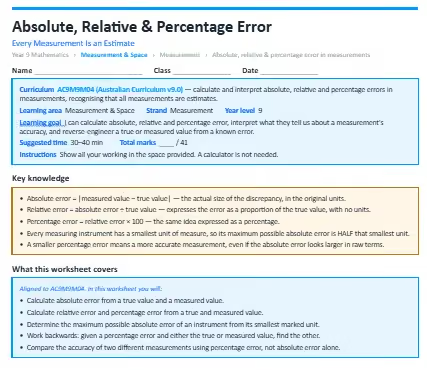
This worksheet introduces measurement error, teaching students to calculate absolute, relative and percentage error, and recognise that every measurement is an estimate. The worksheet is split into warm-up questions, standard questions and then extension questions to test you.
The concepts it covers:
- Absolute error = |measured value − true value| — the actual size of the discrepancy, in the original units.
- Relative error = absolute error ÷ true value — expresses the error as a proportion of the true value, with no units.
- Percentage error = relative error × 100 — the same idea expressed as a percentage.
- Every measuring instrument has a smallest unit of measure, so its maximum possible absolute error is half that smallest unit.
- A smaller percentage error means a more accurate measurement, even if the absolute error looks larger in raw terms.
What your child will practise:
- Calculating absolute error from a true value and a measured value.
- Calculating relative error and percentage error from a true and measured value.
- Determining the maximum possible absolute error of an instrument from its smallest marked unit.
- Working backwards: given a percentage error and either the true or measured value, find the other.
- Comparing the accuracy of two different measurements using percentage error, not absolute error alone.
Every section opens with a worked example, and the download includes a full answer key with step-by-step solutions and teaching notes on the mistakes students most commonly make.
.webp)


.webp)
%20(1).webp)

