
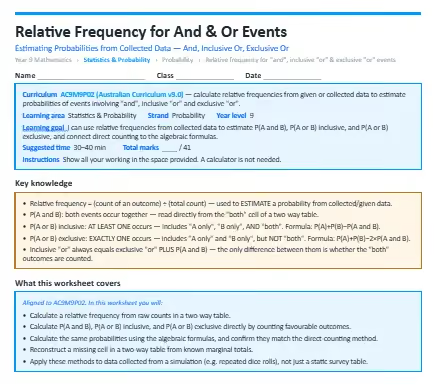
This worksheet teaches students to calculate relative frequencies from data to estimate probabilities involving "and", inclusive "or" and exclusive "or". The worksheet is split into warm-up questions, standard questions and then extension questions to test you.
The concepts it covers:
- Relative frequency = (count of an outcome) ÷ (total count) — used to estimate a probability from collected/given data.
- P(A and B): both events occur together — read directly from the "both" cell of a two-way table.
- P(A or B) inclusive: at least one occurs — includes "A only", "B only", and "both". Formula: P(A)+P(B)−P(A and B).
- P(A or B) exclusive: exactly one occurs — includes "A only" and "B only", but not "both". Formula: P(A)+P(B)−2×P(A and B).
- Inclusive "or" always equals exclusive "or" plus P(A and B) — the only difference between them is whether the "both" outcomes are counted.
What your child will practise:
- Calculating a relative frequency from raw counts in a two-way table.
- Calculating P(A and B), P(A or B) inclusive, and P(A or B) exclusive directly by counting favourable outcomes.
- Calculating the same probabilities using the algebraic formulas, and confirm they match the direct-counting method.
- Reconstructing a missing cell in a two-way table from known marginal totals.
- Applying these methods to data collected from a simulation (e.g. repeated dice rolls), not just a static survey table.
Every section opens with a worked example, and the download includes a full answer key with step-by-step solutions and teaching notes on the mistakes students most commonly make.
.webp)


.webp)
%20(1).webp)

