
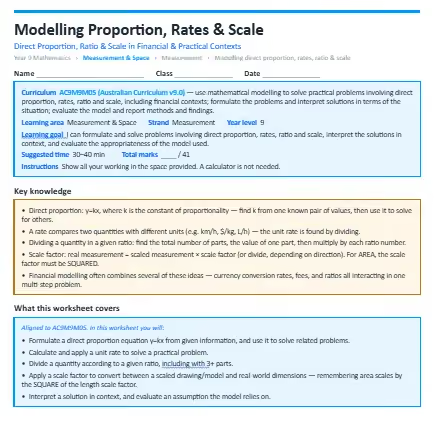
This worksheet applies direct proportion, rates, ratio and scale to real-world and financial modelling problems, requiring students to formulate, solve and interpret each scenario. The worksheet is split into warm-up questions, standard questions and then extension questions to test you.
The concepts it covers:
- Direct proportion: y=kx, where k is the constant of proportionality — find k from one known pair of values, then use it to solve for others.
- A rate compares two quantities with different units (e.g. km/h, $/kg, L/h) — the unit rate is found by dividing.
- Dividing a quantity in a given ratio: find the total number of parts, the value of one part, then multiply by each ratio number.
- Scale factor: real measurement = scaled measurement × scale factor (or divide, depending on direction). For area, the scale factor must be squared.
- Financial modelling often combines several of these ideas — currency conversion rates, fees, and ratios all interacting in one multi-step problem.
What your child will practise:
- Formulating a direct proportion equation y=kx from given information, and use it to solve related problems.
- Calculating and apply a unit rate to solve a practical problem.
- Dividing a quantity according to a given ratio, including with 3+ parts.
- Applying a scale factor to convert between a scaled drawing/model and real-world dimensions — remembering area scales by the square of the length scale factor.
- Interpreting a solution in context, and evaluate an assumption the model relies on.
Every section opens with a worked example, and the download includes a full answer key with step-by-step solutions and teaching notes on the mistakes students most commonly make.
.webp)


.webp)
%20(1).webp)

