
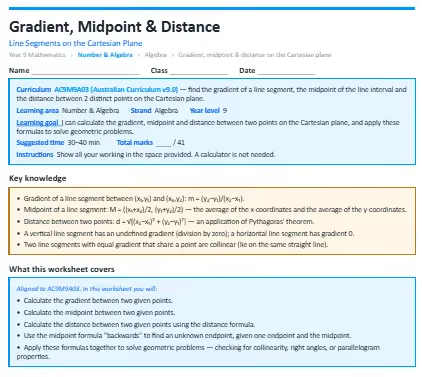
This worksheet introduces coordinate geometry, teaching students to calculate the gradient, midpoint and distance between two points on the Cartesian plane. The worksheet is split into warm-up questions, standard questions and then extension questions to test you.
The concepts it covers:
- Gradient of a line segment between (x₁,y₁) and (x₂,y₂): m = (y₂−y₁)/(x₂−x₁).
- Midpoint of a line segment: M = ((x₁+x₂)/2, (y₁+y₂)/2) — the average of the x-coordinates and the average of the y-coordinates.
- Distance between two points: d = √[(x₂−x₁)² + (y₂−y₁)²] — an application of Pythagoras' theorem.
- A vertical line segment has an undefined gradient (division by zero); a horizontal line segment has gradient 0.
- Two line segments with equal gradient that share a point are collinear (lie on the same straight line).
What your child will practise:
- Calculating the gradient between two given points.
- Calculating the midpoint between two given points.
- Calculating the distance between two given points using the distance formula.
- Using the midpoint formula "backwards" to find an unknown endpoint, given one endpoint and the midpoint.
- Applying these formulas together to solve geometric problems — checking for collinearity, right angles, or parallelogram properties.
Every section opens with a worked example, and the download includes a full answer key with step-by-step solutions and teaching notes on the mistakes students most commonly make.
.webp)


.webp)
%20(1).webp)

