
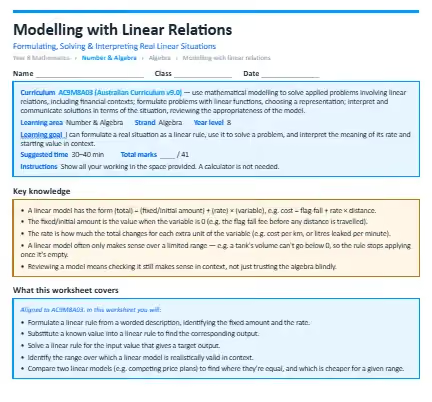
This worksheet applies linear relations to real-world problems, requiring students to formulate a linear model, solve it, and interpret the solution in context. The worksheet is split into warm-up questions, standard questions and then extension questions to test you.
The concepts it covers:
- A linear model has the form (total) = (fixed/initial amount) + (rate) × (variable), e.g. cost = flag-fall + rate × distance.
- The fixed/initial amount is the value when the variable is 0 (e.g. the flag-fall fee before any distance is travelled).
- The rate is how much the total changes for each extra unit of the variable (e.g. cost per km, or litres leaked per minute).
- A linear model often only makes sense over a limited range — e.g. a tank's volume can't go below 0, so the rule stops applying once it's empty.
- Reviewing a model means checking it still makes sense in context, not just trusting the algebra blindly.
What your child will practise:
- Formulating a linear rule from a worded description, identifying the fixed amount and the rate.
- Substituting a known value into a linear rule to find the corresponding output.
- Solving a linear rule for the input value that gives a target output.
- Identifying the range over which a linear model is realistically valid in context.
- Comparing two linear models (e.g. competing price plans) to find where they're equal, and which is cheaper for a given range.
Every section opens with a worked example, and the download includes a full answer key with step-by-step solutions and teaching notes on the mistakes students most commonly make.
.webp)


.webp)
%20(1).webp)

