
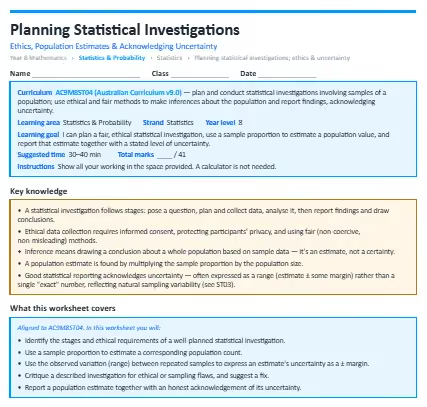
This worksheet introduces planning a statistical investigation, teaching students to use a sample to estimate a population value ethically and fairly, while acknowledging uncertainty in the result. The worksheet is split into warm-up questions, standard questions and then extension questions to test you.
The concepts it covers:
- A statistical investigation follows stages: pose a question, plan and collect data, analyse it, then report findings and draw conclusions.
- Ethical data collection requires informed consent, protecting participants' privacy, and using fair (non-coercive, non-misleading) methods.
- Inference means drawing a conclusion about a whole population based on sample data — it's an estimate, not a certainty.
- A population estimate is found by multiplying the sample proportion by the population size.
- Good statistical reporting acknowledges uncertainty — often expressed as a range (estimate ± some margin) rather than a single "exact" number, reflecting natural sampling variability (see ST03).
What your child will practise:
- Identifying the stages and ethical requirements of a well-planned statistical investigation.
- Using a sample proportion to estimate a corresponding population count.
- Using the observed variation (range) between repeated samples to express an estimate's uncertainty as a ± margin.
- Critiqueing a described investigation for ethical or sampling flaws, and suggest a fix.
- Reporting a population estimate together with an honest acknowledgement of its uncertainty.
Every section opens with a worked example, and the download includes a full answer key with step-by-step solutions and teaching notes on the mistakes students most commonly make.
.webp)


.webp)
%20(1).webp)

