
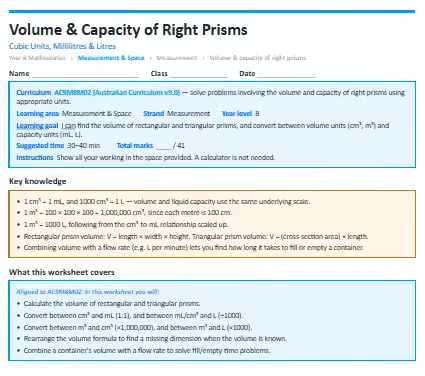
This worksheet applies volume and capacity formulas to right prisms, including converting between units such as cm³, mL, L and m³. The worksheet is split into warm-up questions, standard questions and then extension questions to test you.
The concepts it covers:
- 1 cm³ = 1 mL, and 1000 cm³ = 1 L — volume and liquid capacity use the same underlying scale.
- 1 m³ = 100 × 100 × 100 = 1,000,000 cm³, since each metre is 100 cm.
- 1 m³ = 1000 L, following from the cm³-to-mL relationship scaled up.
- Rectangular prism volume: V = length × width × height. Triangular prism volume: V = (cross-section area) × length.
- Combining volume with a flow rate (e.g. L per minute) lets you find how long it takes to fill or empty a container.
What your child will practise:
- Calculating the volume of rectangular and triangular prisms.
- Converting between cm³ and mL (1:1), and between mL/cm³ and L (÷1000).
- Converting between m³ and cm³ (×1,000,000), and between m³ and L (×1000).
- Rearranging the volume formula to find a missing dimension when the volume is known.
- Combining a container's volume with a flow rate to solve fill/empty-time problems.
Every section opens with a worked example, and the download includes a full answer key with step-by-step solutions and teaching notes on the mistakes students most commonly make.

.webp)


.webp)
%20(1).webp)

