This worksheet builds computational thinking, teaching students to follow and design step-by-step algorithms and function machines, including ones with decisions, and to explain the number patterns they create. The worksheet is split into warm-up questions, standard questions and then extension questions to test you.
The concepts it covers:
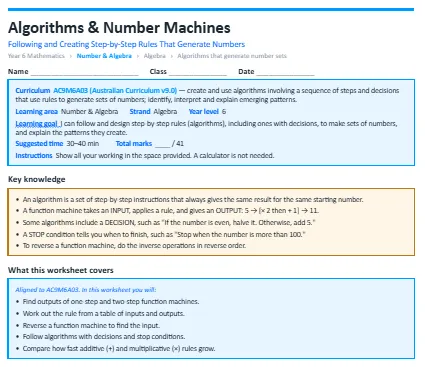
- An algorithm is a set of step-by-step instructions that always gives the same result for the same starting number.
- A function machine takes an input, applies a rule, and gives an output: 5 → [× 2 then + 1] → 11.
- Some algorithms include a decision, such as "If the number is even, halve it. Otherwise, add 5."
- A stop condition tells you when to finish, such as "Stop when the number is more than 100."
- To reverse a function machine, do the inverse operations in reverse order.
What your child will practise:
- Finding outputs of one-step and two-step function machines.
- Working out the rule from a table of inputs and outputs.
- Reversing a function machine to find the input.
- Following algorithms with decisions and stop conditions.
- Comparing how fast additive (+) and multiplicative (×) rules grow.
Every section opens with a worked example, and the download includes a full answer key with step-by-step solutions and teaching notes on the mistakes students most commonly make.