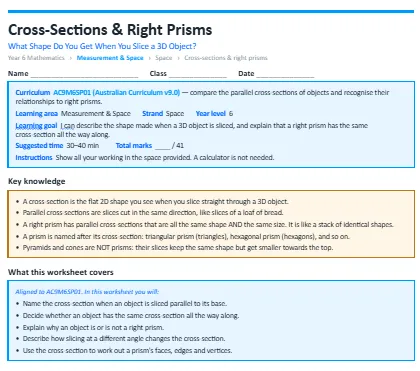
This worksheet explores what happens when 3D objects are sliced, teaching students to identify cross-sections and explain why a right prism has the same cross-section all the way along. The worksheet is split into warm-up questions, standard questions and then extension questions to test you.
The concepts it covers:
- A cross-section is the flat 2D shape you see when you slice straight through a 3D object.
- Parallel cross-sections are slices cut in the same direction, like slices of a loaf of bread.
- A right prism has parallel cross-sections that are all the same shape and the same size. It is like a stack of identical shapes.
- A prism is named after its cross-section: triangular prism (triangles), hexagonal prism (hexagons), and so on.
- Pyramids and cones are not prisms: their slices keep the same shape but get smaller towards the top.
What your child will practise:
- Naming the cross-section when an object is sliced parallel to its base.
- Deciding whether an object has the same cross-section all the way along.
- Explaining why an object is or is not a right prism.
- Describing how slicing at a different angle changes the cross-section.
- Using the cross-section to work out a prism's faces, edges and vertices.
Every section opens with a worked example, and the download includes a full answer key with step-by-step solutions and teaching notes on the mistakes students most commonly make.