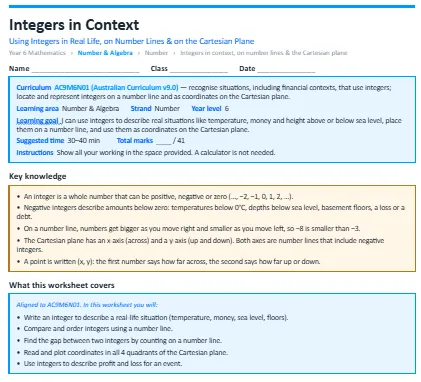
This worksheet introduces negative numbers, teaching students to use integers to describe real situations like temperatures, money and sea level, place them on a number line, and use them as coordinates in all four quadrants. The worksheet is split into warm-up questions, standard questions and then extension questions to test you.
The concepts it covers:
- An integer is a whole number that can be positive, negative or zero (…, −2, −1, 0, 1, 2, …).
- Negative integers describe amounts below zero: temperatures below 0°C, depths below sea level, basement floors, a loss or a debt.
- On a number line, numbers get bigger as you move right and smaller as you move left, so −8 is smaller than −3.
- The Cartesian plane has an x-axis (across) and a y-axis (up and down). Both axes are number lines that include negative integers.
- A point is written (x, y): the first number says how far across, the second says how far up or down.
What your child will practise:
- Writing an integer to describe a real-life situation (temperature, money, sea level, floors).
- Comparing and ordering integers using a number line.
- Finding the gap between two integers by counting on a number line.
- Reading and plotting coordinates in all 4 quadrants of the Cartesian plane.
- Using integers to describe profit and loss for an event.
Every section opens with a worked example, and the download includes a full answer key with step-by-step solutions and teaching notes on the mistakes students most commonly make.