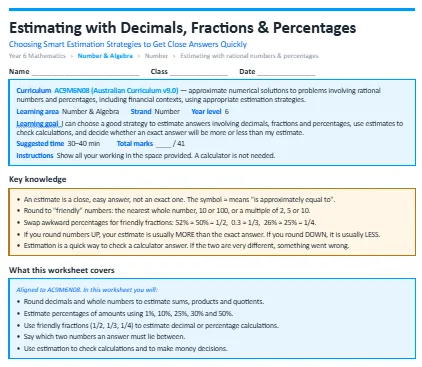
This worksheet builds estimation skills with decimals, fractions and percentages, teaching students to choose a smart rounding strategy, check calculator answers, and judge whether an exact answer will be more or less than their estimate. The worksheet is split into warm-up questions, standard questions and then extension questions to test you.
The concepts it covers:
- An estimate is a close, easy answer, not an exact one. The symbol ≈ means "is approximately equal to".
- Round to "friendly" numbers: the nearest whole number, 10 or 100, or a multiple of 2, 5 or 10.
- Swap awkward percentages for friendly fractions: 52% ≈ 50% = 1/2, 0.3 ≈ 1/3, 26% ≈ 25% = 1/4.
- If you round numbers up, your estimate is usually more than the exact answer. If you round down, it is usually less.
- Estimation is a quick way to check a calculator answer. If the two are very different, something went wrong.
What your child will practise:
- Rounding decimals and whole numbers to estimate sums, products and quotients.
- Estimating percentages of amounts using 1%, 10%, 25%, 30% and 50%.
- Using friendly fractions (1/2, 1/3, 1/4) to estimate decimal or percentage calculations.
- Saying which two numbers an answer must lie between.
- Using estimation to check calculations and to make money decisions.
Every section opens with a worked example, and the download includes a full answer key with step-by-step solutions and teaching notes on the mistakes students most commonly make.