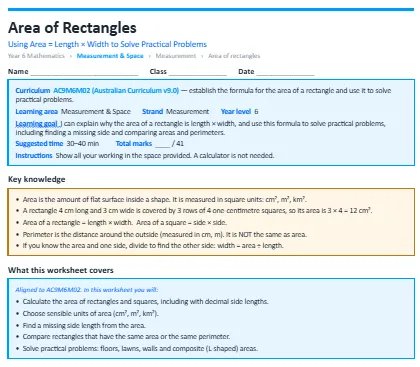
This worksheet teaches students why the area of a rectangle is length times width, and how to use it to solve practical problems, including finding a missing side and comparing areas and perimeters. The worksheet is split into warm-up questions, standard questions and then extension questions to test you.
The concepts it covers:
- Area is the amount of flat surface inside a shape. It is measured in square units: cm², m², km².
- A rectangle 4 cm long and 3 cm wide is covered by 3 rows of 4 one-centimetre squares, so its area is 3 × 4 = 12 cm².
- Area of a rectangle = length × width. Area of a square = side × side.
- Perimeter is the distance around the outside (measured in cm, m). It is not the same as area.
- If you know the area and one side, divide to find the other side: width = area ÷ length.
What your child will practise:
- Calculating the area of rectangles and squares, including with decimal side lengths.
- Choosing sensible units of area (cm², m², km²).
- Finding a missing side length from the area.
- Comparing rectangles that have the same area or the same perimeter.
- Solving practical problems: floors, lawns, walls and composite (L-shaped) areas.
Every section opens with a worked example, and the download includes a full answer key with step-by-step solutions and teaching notes on the mistakes students most commonly make.