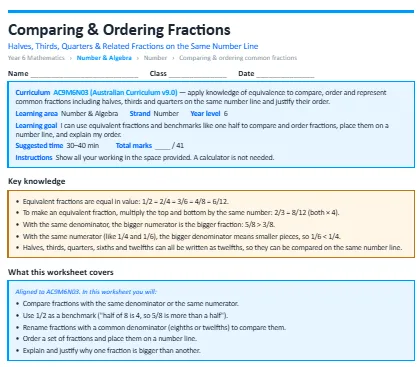
This worksheet teaches students to compare and order halves, thirds, quarters and related fractions using equivalent fractions, the one-half benchmark and number lines, and to explain their order. The worksheet is split into warm-up questions, standard questions and then extension questions to test you.
The concepts it covers:
- Equivalent fractions are equal in value: 1/2 = 2/4 = 3/6 = 4/8 = 6/12.
- To make an equivalent fraction, multiply the top and bottom by the same number: 2/3 = 8/12 (both × 4).
- With the same denominator, the bigger numerator is the bigger fraction: 5/8 > 3/8.
- With the same numerator (like 1/4 and 1/6), the bigger denominator means smaller pieces, so 1/6 < 1/4.
- Halves, thirds, quarters, sixths and twelfths can all be written as twelfths, so they can be compared on the same number line.
What your child will practise:
- Comparing fractions with the same denominator or the same numerator.
- Using 1/2 as a benchmark ("half of 8 is 4, so 5/8 is more than a half").
- Renaming fractions with a common denominator (eighths or twelfths) to compare them.
- Ordering a set of fractions and place them on a number line.
- Explaining and justifying why one fraction is bigger than another.
Every section opens with a worked example, and the download includes a full answer key with step-by-step solutions and teaching notes on the mistakes students most commonly make.