This worksheet builds number sense with prime, composite and square numbers, teaching students to test for primes by dividing, write numbers as products of factors, and use factors to make multiplication easier. The worksheet is split into warm-up questions, standard questions and then extension questions to test you.
The concepts it covers:
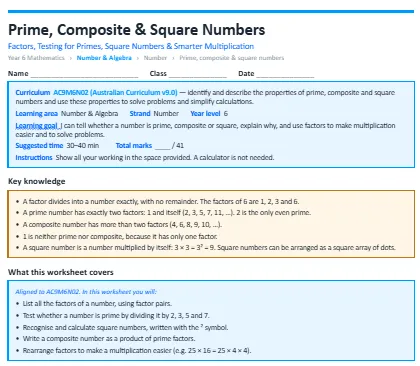
- A factor divides into a number exactly, with no remainder. The factors of 6 are 1, 2, 3 and 6.
- A prime number has exactly two factors: 1 and itself (2, 3, 5, 7, 11, …). 2 is the only even prime.
- A composite number has more than two factors (4, 6, 8, 9, 10, …).
- 1 is neither prime nor composite, because it has only one factor.
- A square number is a number multiplied by itself: 3 × 3 = 3² = 9. Square numbers can be arranged as a square array of dots.
What your child will practise:
- Listing all the factors of a number, using factor pairs.
- Testing whether a number is prime by dividing it by 2, 3, 5 and 7.
- Recognising and calculating square numbers, written with the ² symbol.
- Writing a composite number as a product of prime factors.
- Rearranging factors to make a multiplication easier (e.g. 25 × 16 = 25 × 4 × 4).
Every section opens with a worked example, and the download includes a full answer key with step-by-step solutions and teaching notes on the mistakes students most commonly make.