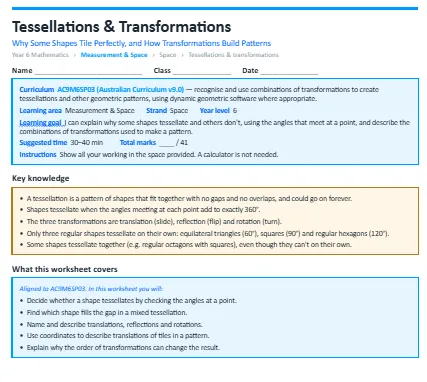
This worksheet teaches students why some shapes tessellate and others don't by checking the angles that meet at a point, and how translations, reflections and rotations combine to build patterns. The worksheet is split into warm-up questions, standard questions and then extension questions to test you.
The concepts it covers:
- A tessellation is a pattern of shapes that fit together with no gaps and no overlaps, and could go on forever.
- Shapes tessellate when the angles meeting at each point add to exactly 360°.
- The three transformations are translation (slide), reflection (flip) and rotation (turn).
- Only three regular shapes tessellate on their own: equilateral triangles (60°), squares (90°) and regular hexagons (120°).
- Some shapes tessellate together (e.g. regular octagons with squares), even though they can't on their own.
What your child will practise:
- Deciding whether a shape tessellates by checking the angles at a point.
- Finding which shape fills the gap in a mixed tessellation.
- Naming and describing translations, reflections and rotations.
- Using coordinates to describe translations of tiles in a pattern.
- Explaining why the order of transformations can change the result.
Every section opens with a worked example, and the download includes a full answer key with step-by-step solutions and teaching notes on the mistakes students most commonly make.