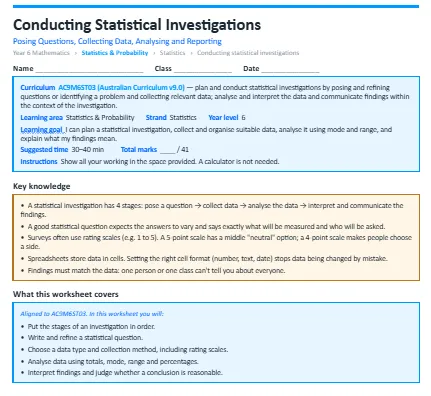
This worksheet walks students through a full statistical investigation, from posing and refining a question to collecting, analysing and interpreting data and drawing a fair conclusion. The worksheet is split into warm-up questions, standard questions and then extension questions to test you.
The concepts it covers:
- A statistical investigation has 4 stages: pose a question → collect data → analyse the data → interpret and communicate the findings.
- A good statistical question expects the answers to vary and says exactly what will be measured and who will be asked.
- Surveys often use rating scales (e.g. 1 to 5). A 5-point scale has a middle "neutral" option; a 4-point scale makes people choose a side.
- Spreadsheets store data in cells. Setting the right cell format (number, text, date) stops data being changed by mistake.
- Findings must match the data: one person or one class can't tell you about everyone.
What your child will practise:
- Putting the stages of an investigation in order.
- Writing and refining a statistical question.
- Choosing a data type and collection method, including rating scales.
- Analysing data using totals, mode, range and percentages.
- Interpreting findings and judge whether a conclusion is reasonable.
Every section opens with a worked example, and the download includes a full answer key with step-by-step solutions and teaching notes on the mistakes students most commonly make.