
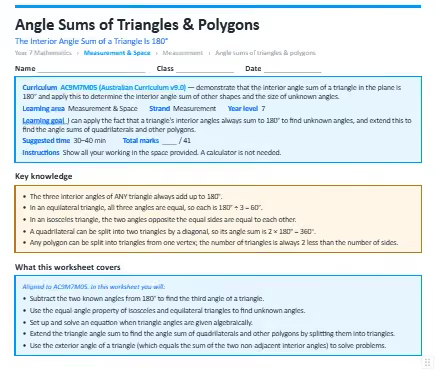
This worksheet applies the fact that a triangle's interior angles always sum to 180°, extending this to find the angle sums of quadrilaterals and other polygons. The worksheet is split into warm-up questions, standard questions and then extension questions to test you.
The concepts it covers:
- The three interior angles of any triangle always add up to 180°.
- In an equilateral triangle, all three angles are equal, so each is 180° ÷ 3 = 60°.
- In an isosceles triangle, the two angles opposite the equal sides are equal to each other.
- A quadrilateral can be split into two triangles by a diagonal, so its angle sum is 2 × 180° = 360°.
- Any polygon can be split into triangles from one vertex; the number of triangles is always 2 less than the number of sides.
What your child will practise:
- Subtracting the two known angles from 180° to find the third angle of a triangle.
- Using the equal-angle property of isosceles and equilateral triangles to find unknown angles.
- Seting up and solve an equation when triangle angles are given algebraically.
- Extending the triangle angle sum to find the angle sum of quadrilaterals and other polygons by splitting them into triangles.
- Using the exterior angle of a triangle (which equals the sum of the two non-adjacent interior angles) to solve problems.
Every section opens with a worked example, and the download includes a full answer key with step-by-step solutions and teaching notes on the mistakes students most commonly make.
.webp)


.webp)
%20(1).webp)

